
Roof Top Tent vs Ground Tent: Which Is Better for Australians?

Picture this: you’ve just arrived at a remote bush camp after hours on corrugated dirt roads. It’s dark, the mozzies are out, and something rustles in the grass nearby. When comparing a roof top tent vs ground tent, neither is universally better – it genuinely depends on how, where, and with whom you camp. Ground tents win on budget and flexibility.
Roof top tents win on comfort, setup speed, and keeping you off Australia’s snake-and-spider-filled ground. Both have real trade-offs that Aussie campers often discover too late. This guide covers cost, weather performance, wildlife safety, vehicle compatibility, and which option suits your camping style best.
What’s the Actual Difference Between a Roof Top Tent and a Ground Tent?
The difference goes well beyond where you sleep. These two shelter systems are built around completely different camping philosophies.
A ground tent sits directly on the earth. You peg it out, stake it down, and sleep at ground level. Most Australians grow up using them. They pack into a bag, fit in your boot, and work on almost any flat surface. A quality three-person dome tent weighs around 3 to 5 kilograms. Budget options start at $80, and premium canvas cabin tents can reach $800.
A roof top tent mounts permanently onto your vehicle’s roof rack or tray. You drive to camp, unclip the cover, and the tent either folds out or pops up. Your sleeping platform stays fixed to the vehicle.
Most soft-shell RTTs weigh between 35 and 55 kilograms. Hard-shell models like the Darche KOZI or ARB Simpson series sit between 45 and 80 kilograms. Entry-level RTTs start around $900, with premium setups hitting $4,500 or more.
Here is a straight comparison across the key differences:
| Feature | Roof Top Tent | Ground Tent |
|---|---|---|
| Setup location | On vehicle roof or tray | Any flat ground |
| Setup time | 2 to 5 minutes | 10 to 20 minutes |
| Weight | 35 to 80 kg | 2 to 8 kg |
| Entry price (AUD) | $900 + rack costs | $80 to $800 |
| Mattress included | Yes, usually foam | No, separate purchase |
| Ground contact | None | Direct |
| Vehicle required | Yes, with roof load rating | No |
The engineering behind each system reflects a different priority. Ground tents prioritise portability and accessibility. Roof top tents prioritise comfort, speed, and elevation. Neither system is superior overall. But once you understand how each one is built and why, choosing the right one for your style of camping becomes much clearer.
Which One Is Faster to Set Up and Pack Down?
A roof top tent wins this comparison every single time. Take the Rigdup 1.8m Hard Shell Roof Top Tent as a good example. Its aerodynamic hard shell design opens in under sixty seconds. Your 40mm memory foam mattress stays inside. Your bedding stays put. You climb straight in after a long drive with zero fuss.
A ground tent is a completely different experience. Even a seasoned camper takes ten to fifteen minutes to pitch a dome tent properly. You need flat ground, working pegs, and enough light to handle the poles. On rocky outback terrain or in wet conditions, that time stretches even further.
Pack-down tells the same story. Rolling a damp tent, stuffing a wet fly back into its carry bag, and squeezing it into your boot is genuinely frustrating. The Rigdup hard shell simply folds down, clips closed with its YKK zippers, and sits flush on your roof rack. You are back on the road in under two minutes.
For Australians running long remote tours through Western Australia or the Northern Territory, that time saving compounds fast across a two-week trip.
How Do They Handle Australia’s Harsh Weather Conditions?
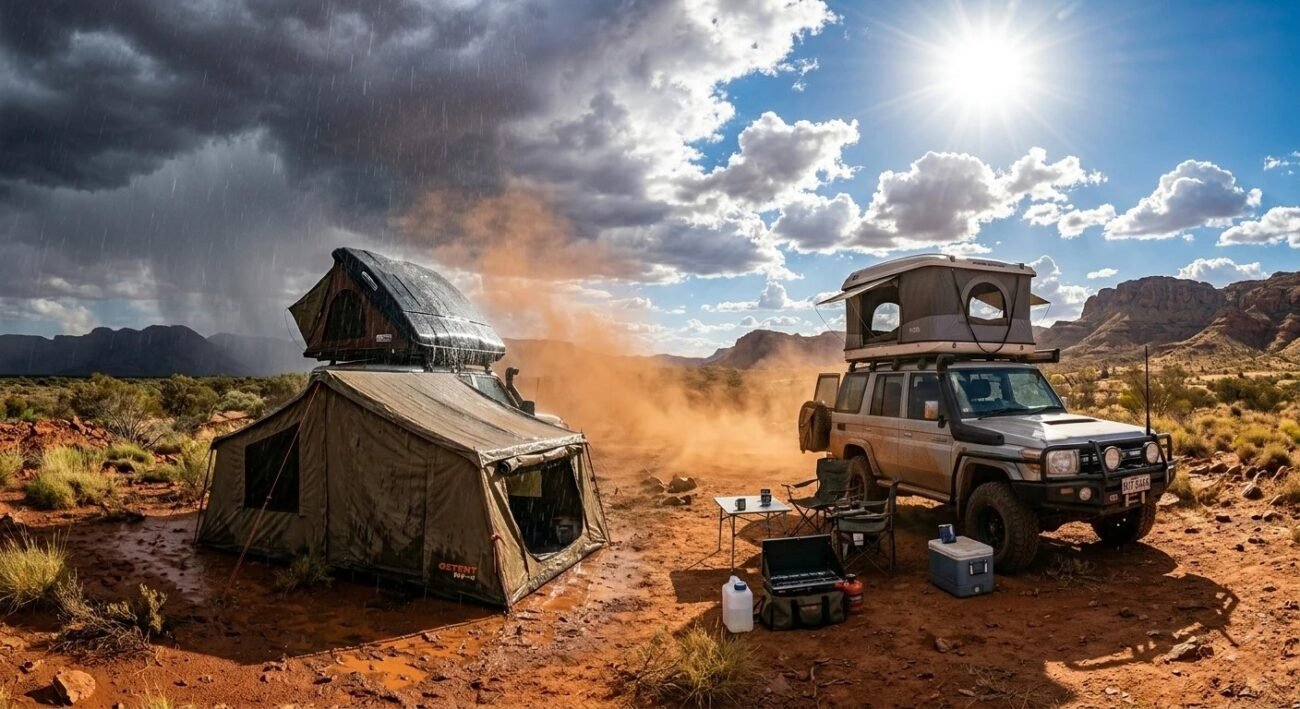
Australia does not do mild weather. You are dealing with outback heat pushing 45 degrees, tropical downpours in the Top End, coastal winds along the Nullarbor, and freezing alpine nights in the Snowy Mountains. Your shelter needs to handle all of it.
Ground tents struggle most in prolonged heavy rain. Water pools underneath, seams leak over time, and a flooded tent floor ruins a trip fast. Quality canvas cabin tents like the Oztent RV-5 handle rain well, but budget nylon tents do not. Heat is also brutal inside a low-pitched dome tent with no airflow underneath.
Roof top tents handle rain better because water runs straight off the sides with no pooling underneath. Elevation also means better airflow on hot nights. However, hard-shell RTTs can turn into an oven if parked facing full western sun all afternoon. Positioning your vehicle matters more than people realise.
For dust, RTTs have the edge. Outback dust gets into everything at ground level. Sleeping two metres off the ground with a decent zip-up fly makes a real difference on those corrugated station tracks through the Northern Territory and Western Australia.
Are You Actually Safer from Snakes and Spiders in a Roof Top Tent?
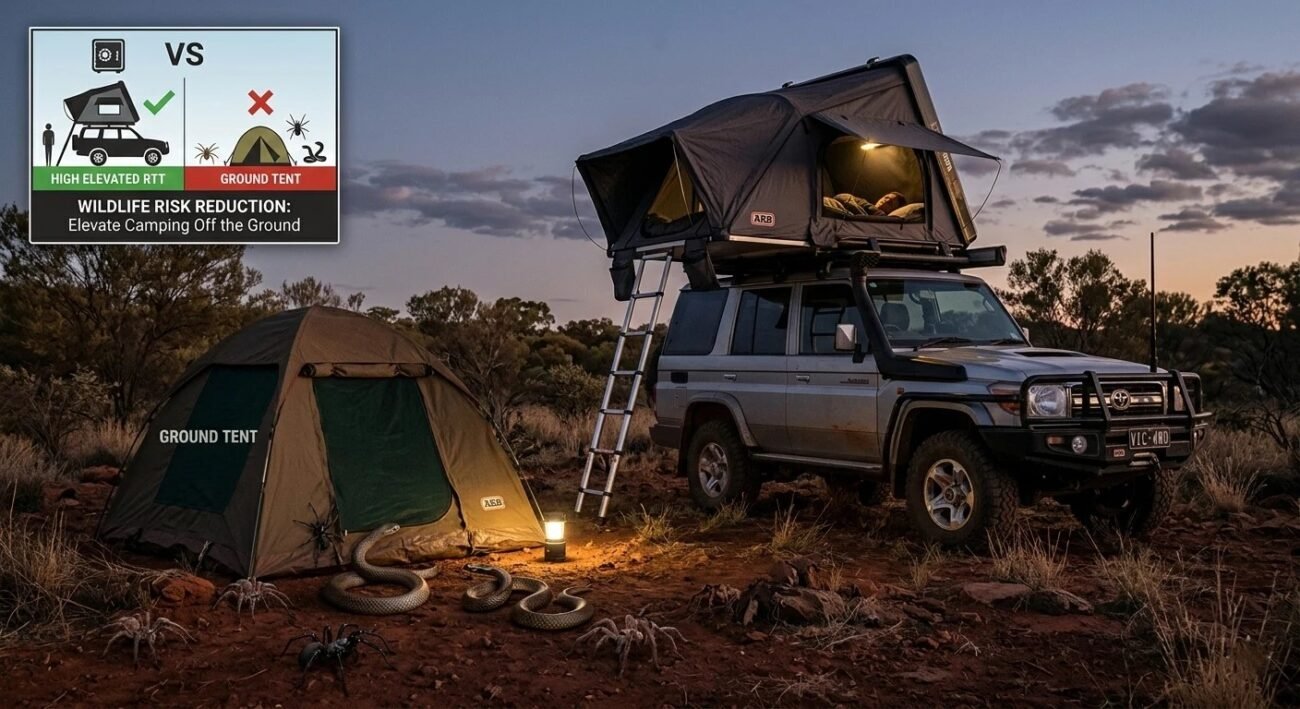
This is one of the biggest selling points RTT brands lean on, and honestly, it holds up, but with some important context.
Eastern browns, tiger snakes, and taipans are ground dwellers. They follow scent trails, warmth, and movement. Sleeping at ground level, especially near logs, long grass, or water, puts you closer to their natural habitat. A ground tent gives you a zip and some nylon between you and whatever is outside. That is not a lot of reassurance at 2am in Cape York.
An RTT puts you roughly 1.5 to 2 metres off the ground. Snakes do not climb smooth aluminium ladders or vehicle panels without reason. Your actual contact risk drops significantly. I have camped across the Kimberley and Katherine region for years, and the peace of mind alone is worth something real.
Spiders are a slightly different story. Redbacks and huntsmen love sheltered, dark spaces. They will happily move into your RTT cover if it sits unwashed for weeks. Regular checks and a can of surface spray inside the cover fixes that quickly. The RTT still wins on wildlife safety overall, but it is not completely risk-free without basic maintenance habits.
How Comfortable Is Sleeping in Each One?
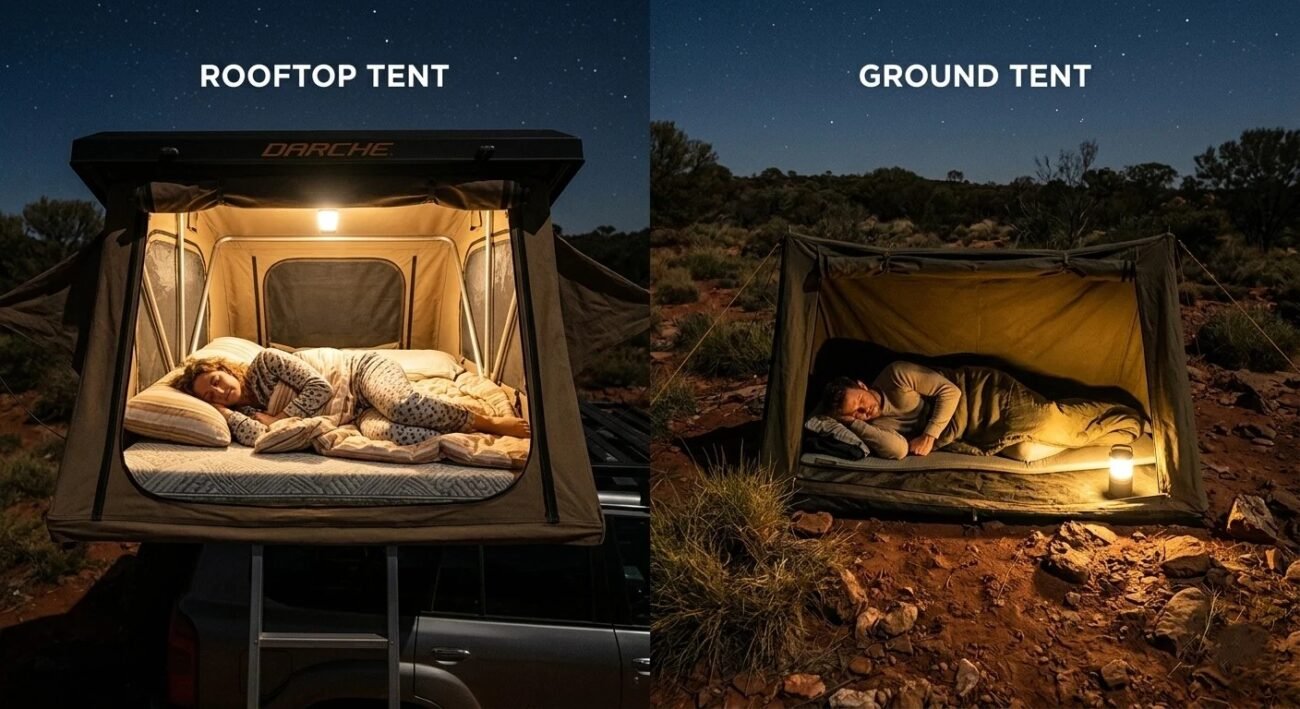
Comfort is where roof top tents genuinely pull ahead, and the gap is bigger than most first-time buyers expect.
Most RTTs come with a high-density foam mattress already built in, typically 50 to 75 millimetres thick. Brands like Rhino-Rack Batwing and ARB Simpson include decent foam as standard. You are not sleeping on the ground, there is no rocky surface poking through, and the base is solid and flat every single night regardless of the terrain below.
Ground tents require a separate sleeping mat or air mattress. Even a quality self-inflating mat like a Therm-a-Rest NeoAir does a solid job, but you are still managing an extra piece of gear, and uneven or rocky ground affects your sleep directly.
Temperature regulation is where it gets more nuanced. RTTs get better airflow underneath in summer, which helps. But in winter, cold air circulates beneath the tent floor, and you need a proper sleeping bag rated below zero for alpine trips. Ground tents insulate slightly better from cold because the earth retains some warmth overnight.
For couples doing long touring trips across Australia, the RTT comfort advantage is hard to argue against after the first week on the road.
How Much Does Each One Cost, and Is a Roof Top Tent Worth the Money?
Ground Tent Costs
Ground tents are genuinely accessible for almost any budget. A basic nylon dome tent from Kmart or BCF starts around $80 to $150. These work fine for occasional weekend trips in mild conditions. Step up to a mid-range option like a Coleman Instant Up or Oztrail Lodge, and you are spending $200 to $400. These offer better weatherproofing and more reliable poles.
A premium canvas cabin tent like the Oztent RV-5 or Darche Barra 9 sits between $500 and $900. These last years with proper care and handle Australian conditions well. You will still need to budget separately for a sleeping mat, which adds another $60 to $300 depending on quality.
Ground tents cost less upfront. But cheaper tents wear out faster and often need replacing every two to three seasons if used regularly. Over five years of regular camping, a quality $500 canvas tent often works out cheaper than replacing budget tents repeatedly.
Roof Top Tent Costs
RTTs require a larger upfront investment, and it is important to understand exactly what that investment covers. Entry-level soft-shell RTTs start around $900 to $1,200. These are functional but often use thinner canvas and lighter foam. Mid-range options like the Rigdup 1.4m Soft Shell sit at $3,200 and include meaningful upgrades. You get a 70mm memory foam mattress, 320gsm ripstop poly-cotton canvas, YKK zippers, integrated solar panel mounting, and a 260cm ladder suited to lifted vehicles.
The Rigdup 1.8m Hard Shell comes in at $3,400. That gets you an aluminium honeycomb base, aerodynamic hard shell, 40mm memory foam, carpeted flooring with an anti-condensation mat, a 12V Anderson plug, and crossbars included. Premium imported brands push $4,500 and beyond.
You also need compatible roof racks if you do not already have them. Budget $400 to $1,000 for quality crossbars and fitting. Over three to five years of regular touring, the cost per trip on a quality RTT becomes very reasonable, especially when comfort and setup time factor in.
Does a Roof Top Tent Suit Every Vehicle or Is Yours Not Compatible?
Not every vehicle can carry a roof top tent safely, and this is something dealers do not always explain clearly upfront. Every vehicle has two separate load ratings you need to understand. The static load rating is how much weight your roof can hold when the vehicle is completely stationary. The dynamic load rating is how much weight it can carry while the vehicle is moving. These numbers are very different.
Most passenger cars have a dynamic roof load rating of 50 to 75 kilograms. An RTT alone weighs 45 to 80 kilograms before you add roof racks. This means many standard sedans and small SUVs simply cannot handle an RTT legally or safely while driving.
Dual-cab utes like the Toyota HiLux, Ford Ranger, and Isuzu D-MAX work very well. Large 4WDs like the LandCruiser 200 Series, Nissan Patrol, and Mitsubishi Pajero are well suited too. Mid-size SUVs like the Prado and Everest generally work with the right rack setup.
Always check your vehicle’s handbook for the dynamic roof load rating before purchasing. If you want a full breakdown of compatible makes and models, we have covered it in detail over here.
How Does Each One Affect Your Fuel Economy on Long Drives?
Roof Top Tent – Fuel Impact
- An RTT adds significant aerodynamic drag due to its size and height on the roof.
- A soft-shell RTT increases your vehicle’s frontal area and disrupts clean airflow noticeably.
- Most Australian tourers report a 10 to 15 percent increase in fuel consumption on highway runs.
- At 110km/h, aerodynamic drag grows significantly compared to lower speeds.
- Hard-shell RTTs like the Rigdup 1.8m use an aerodynamic low-profile design to reduce drag.
- The Rigdup hard shell sits closer to the roofline, which reduces wind resistance compared to boxy soft shells.
- Even with an aerodynamic shell, expect a 7 to 12 percent fuel increase on long open-road drives.
- On a 3,000km trip across the Nullarbor, that fuel difference adds up to a real cost.
Ground Tent – Fuel Impact
- A ground tent packed in your boot or on a rear carrier has almost zero impact on fuel economy.
- Boot-stored tents add negligible weight and create no additional aerodynamic drag at speed.
- A rooftop cargo box carrying a ground tent creates some drag, but far less than an RTT.
- Ground tents give you full fuel efficiency on every highway leg of your trip.
- For budget-conscious touring across large distances, this difference is genuinely worth considering.
Which One Is Better for Families and Kids?
| Factor | Roof Top Tent | Ground Tent |
|---|---|---|
| Sleeping space | Limited, suits couples or two small children | Large cabin tents sleep 4 to 6 comfortably |
| Ladder safety | Risky for children under 6, needs supervision | No ladder needed, children move freely |
| Night toilet runs | Inconvenient, child must climb down ladder in the dark | Easy, unzip and step outside directly |
| Cost for family setup | Requires two RTTs for a family of four, doubles cost | One large canvas tent covers the whole family |
| Wildlife protection | Elevated sleeping reduces ground-level wildlife risk | Ground contact increases snake and spider exposure |
| Campsite flexibility | Needs a vehicle present at all times | Can be pitched anywhere away from vehicles |
| Bedtime routine | Harder to settle young children up a ladder | Easy to put kids down directly on sleeping mats |
| Bad weather experience | Dry entry, no wet groundsheet, better drainage | Flooded floors possible in heavy rain |
| Value for families | Better for older kids and teens on 4WD tours | Better overall for families with young children |
For families with children under ten, a quality canvas cabin tent like the Oztent RV-5 or Darche Barra simply makes daily camp life easier and safer.
What About Space – Living Room, Gear Storage, and Privacy?
| Factor | Roof Top Tent | Ground Tent |
|---|---|---|
| Sleeping space | 210cm x 180cm (1.8m Rigdup) or 210cm x 145cm (1.4m Rigdup) | Varies widely, cabin tents offer 3m x 3m+ |
| Sitting height | 100cm hard shell, 150cm soft shell (Rigdup specs) | Up to 200cm in full cabin tents |
| Gear storage inside | Minimal, sleeping area only | Large vestibules, separate rooms possible |
| Leaving camp set up | Cannot drive off without packing down completely | Leave tent standing, drive away freely |
| Privacy from neighbours | Elevated and visible to entire campground | Ground level, easier to screen with tarps |
| Living room space | None built in, need separate awning setup | Annexes and add-on rooms available |
| Wet weather entry | Climb ladder in rain, gear gets wet | Step directly inside, vestibule keeps boots dry |
| Campsite footprint | Small, only vehicle space needed | Larger footprint, needs clear flat ground |
| Gear storage outside | Under vehicle or in drawers | Under fly or in separate storage tent |
The biggest practical limitation of an RTT is that your camp disappears the moment you want to drive somewhere. A ground tent stays standing while you explore for the day.
Is There a Third Option Aussies Often Overlook?
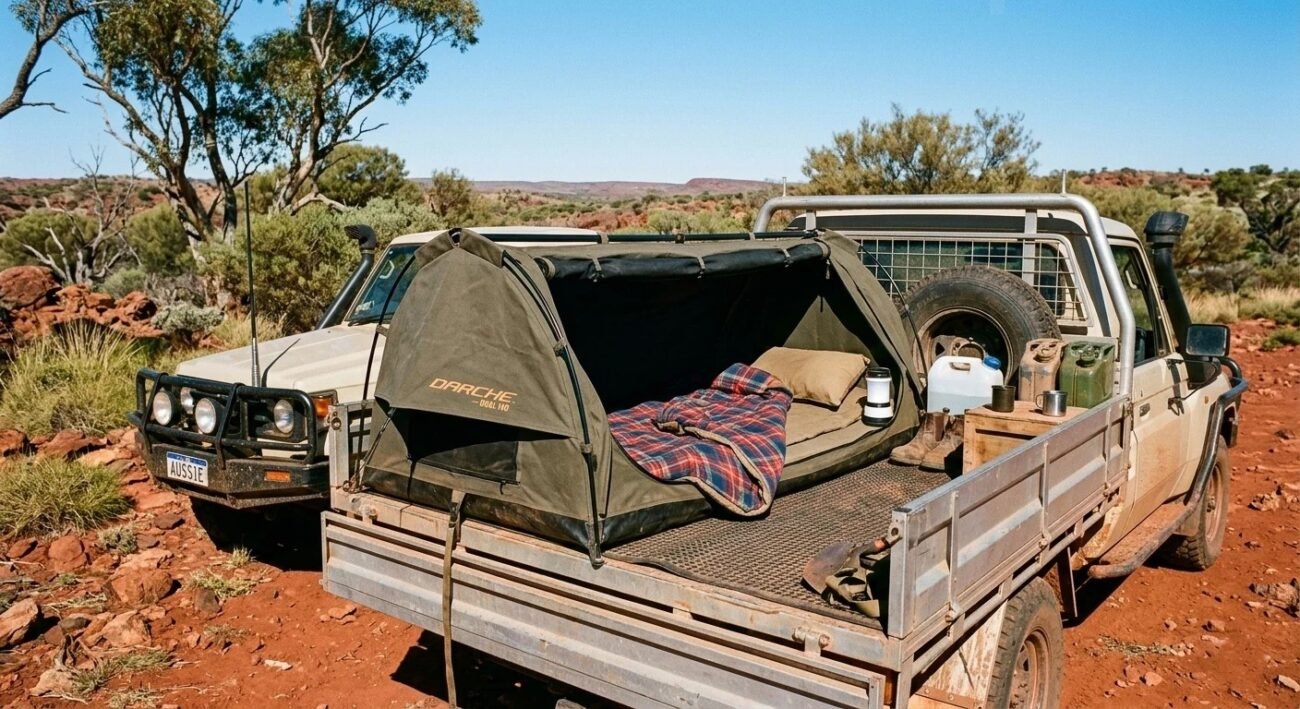
Most roof top tent versus ground tent comparisons completely ignore the swag, which is genuinely strange because swags are deeply Australian and incredibly practical for solo travellers and couples.
A canvas swag is essentially a self-contained sleeping system. It combines a mattress, a waterproof canvas shell, and a built-in sleeping bag liner into one compact roll. Quality brands like Darche, OzTent, and Swagman produce double swags that comfortably sleep two adults. A solid double swag costs $300 to $700, making it far cheaper than an RTT.
The advantages are real. A swag sets up in under sixty seconds. You unroll it, unzip it, and you are done. It sits low to the ground, which means wind and condensation are minimal. Canvas breathes naturally, so heat management is noticeably better than nylon tents on warm nights. Packed down, a double swag fits neatly in your ute tray or boot without dominating your storage.
The honest limitation is wildlife exposure. You are sleeping at ground level with canvas between you and whatever shares your campsite. For serious snake country in the Kimberley or Cape York, a swag requires more vigilance than an RTT. But for well-maintained campgrounds across New South Wales, Victoria, and South Australia, a quality swag is hard to beat for value and simplicity.
Which One Suits Your Style of Camping in Australia?
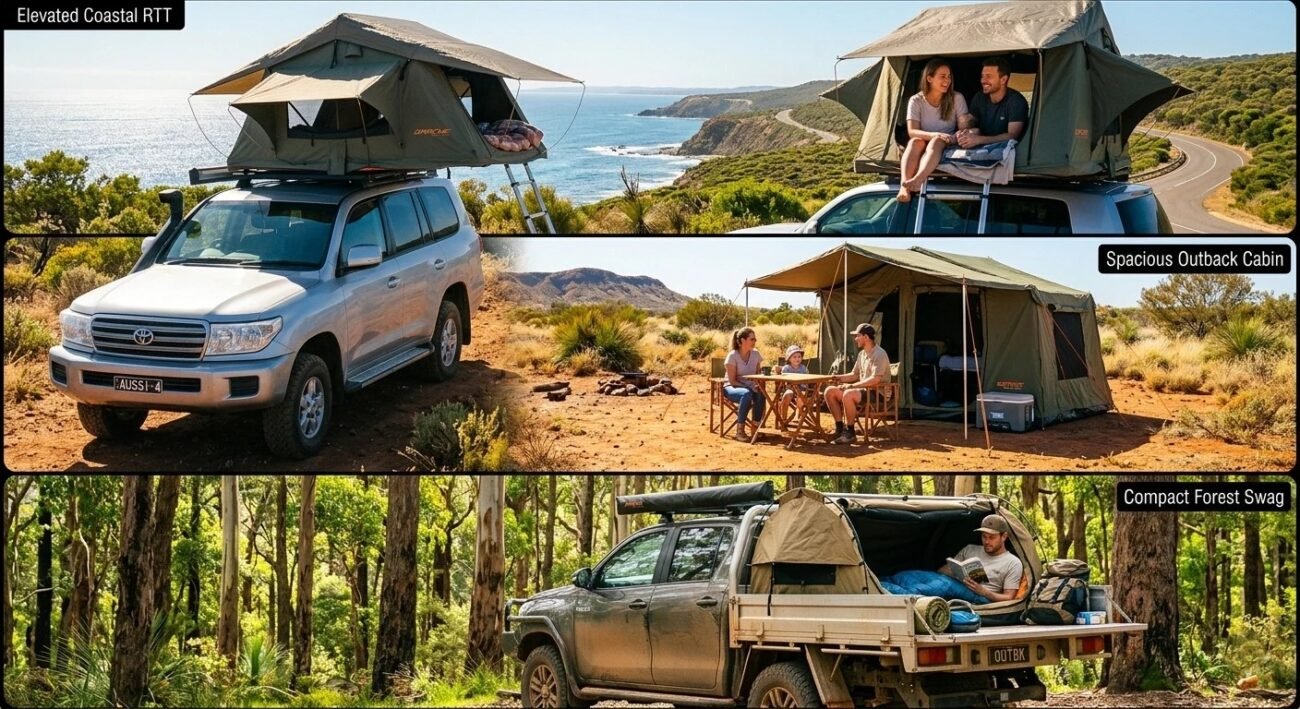
Your camping style should drive this decision completely. There is no universally correct answer, and anyone who tells you otherwise is selling something.
If you are a weekend warrior doing caravan parks and established campgrounds around coastal New South Wales or Victoria, a quality mid-range ground tent like the Oztent RV-5 gives you everything you need at a fraction of the cost. You get space, comfort, and flexibility without spending $3,000 plus on rack and tent combined.
If you are doing serious remote touring through the Kimberley, the Gibb River Road, or Cape York, an RTT like the Rigdup 1.8m Hard Shell makes daily camp life dramatically easier. Fast setup, elevated sleeping, integrated solar, and an Anderson plug underneath means your camp is functional within minutes of stopping.
Solo travellers covering big distances on a budget do well with a premium double swag. It is fast, simple, and genuinely rugged. Families with young children almost always find a large canvas cabin tent more practical than any RTT setup for daily camp management.
The honest filter is this: if you camp more than fifteen nights a year in remote or variable conditions, an RTT investment pays off quickly in comfort and time saved. If you camp occasionally in accessible locations, a ground tent or swag is smarter money.
What Are the Most Common Regrets People Have After Choosing the Wrong One?
Regrets From Ground Tent Buyers:
- “I didn’t realise how much time pitching camp every night actually takes across a two-week trip.”
- “Sleeping on rocky ground through a $60 mat destroyed my back by day four.”
- “Our tent flooded on night two in Queensland and everything inside got soaked.”
- “I had no idea how terrifying it felt hearing something moving around outside the tent in snake country.”
- “We kept finding spiders and ants inside the tent every single morning.”
Regrets From Roof Top Tent Buyers:
- “I never checked my vehicle’s dynamic roof load rating and had to buy a whole new rack system.”
- “We couldn’t leave camp set up and go exploring because the tent was on our only vehicle.”
- “Fuel costs on our Nullarbor crossing were way higher than expected with the RTT on the roof.”
- “The ladder at 2am with a torch in the rain was genuinely miserable every single time.”
- “We needed more sleeping space for the kids and ended up buying a ground tent anyway.”
So, Which One Is Actually Better for Australians?
After years of camping across this country, from the red dirt of the Pilbara to the rainforests of Far North Queensland, my honest answer is that both systems earn their place depending on who you are and how you travel.
Roof top tents genuinely change the camping experience for serious tourers. The Rigdup 1.8m Hard Shell, priced at $3,400 with crossbars included, represents strong value when you factor in the integrated solar panel, anti-condensation mat, 40mm memory foam, and Anderson plug setup. You arrive tired, you are set up in sixty seconds, and you sleep elevated and comfortable. That matters enormously after a twelve-hour driving day on corrugated dirt.
Ground tents still make more sense for families, occasional campers, and anyone on a tighter budget. A quality canvas tent used well over five years costs far less per night than any RTT setup.
Personally, if I am doing a long remote tour in a 4WD with a high-clearance setup, I am reaching for an RTT without hesitation. The wildlife comfort alone on a remote station track is worth it. But if I am heading to a well-maintained campground with the family for a long weekend, a solid canvas cabin tent is still the smarter and more practical call.
Buy for how you actually camp, not for how you imagine you might camp one day. Explore our complete guide for Roof Top Tent Comparisons & Reviews right here.
FAQs
Yes, most caravan parks allow roof top tents without any issues. Always call ahead to confirm powered site access and height restrictions. Some older parks have low-clearance boom gates. Knowing before you arrive saves a frustrating turnaround at the entrance.
A well-maintained RTT from a reputable brand lasts eight to fifteen years easily. Canvas care, UV protection spray, and proper drying before storage are the biggest factors. Cheap imported tents with thin canvas degrade much faster under Australia’s harsh sun and outback dust.
Quality hard shell and canvas RTTs handle heavy tropical rain very well. Water runs off the sides without pooling underneath. Always check your fly seams annually and re-seal them if needed. A quality RTT outperforms most budget ground tents in prolonged wet season downpours significantly.
Lightweight soft-shell RTTs start around 35 kilograms. Some compact models designed for smaller SUVs sit closer to 28 to 32 kilograms. Always cross-check your vehicle’s dynamic roof load rating first. The tent weight plus rack weight combined must stay within your vehicle’s rated roof capacity.
Yes, especially for alpine or southern Australian winter camping. Cold air circulates beneath an RTT floor, making it feel colder than ground sleeping in some conditions. A sleeping bag rated to minus five degrees Celsius handles most Australian winter camping destinations comfortably and safely.
Yes, most RTTs are transferable between vehicles provided both have compatible roof rack crossbar spacing. Crossbar spacing typically needs to sit between 60 and 90 centimetres apart. Always recheck load ratings on your second vehicle before assuming the transfer is safe and road legal.
Always dry your canvas tent completely before packing it away. Storing a damp canvas tent causes mould and mildew within days. Re-season canvas every one to two years using a quality canvas conditioner like Canvacon or Atsko. Clean dirt off the fly with a soft brush and cold water only.