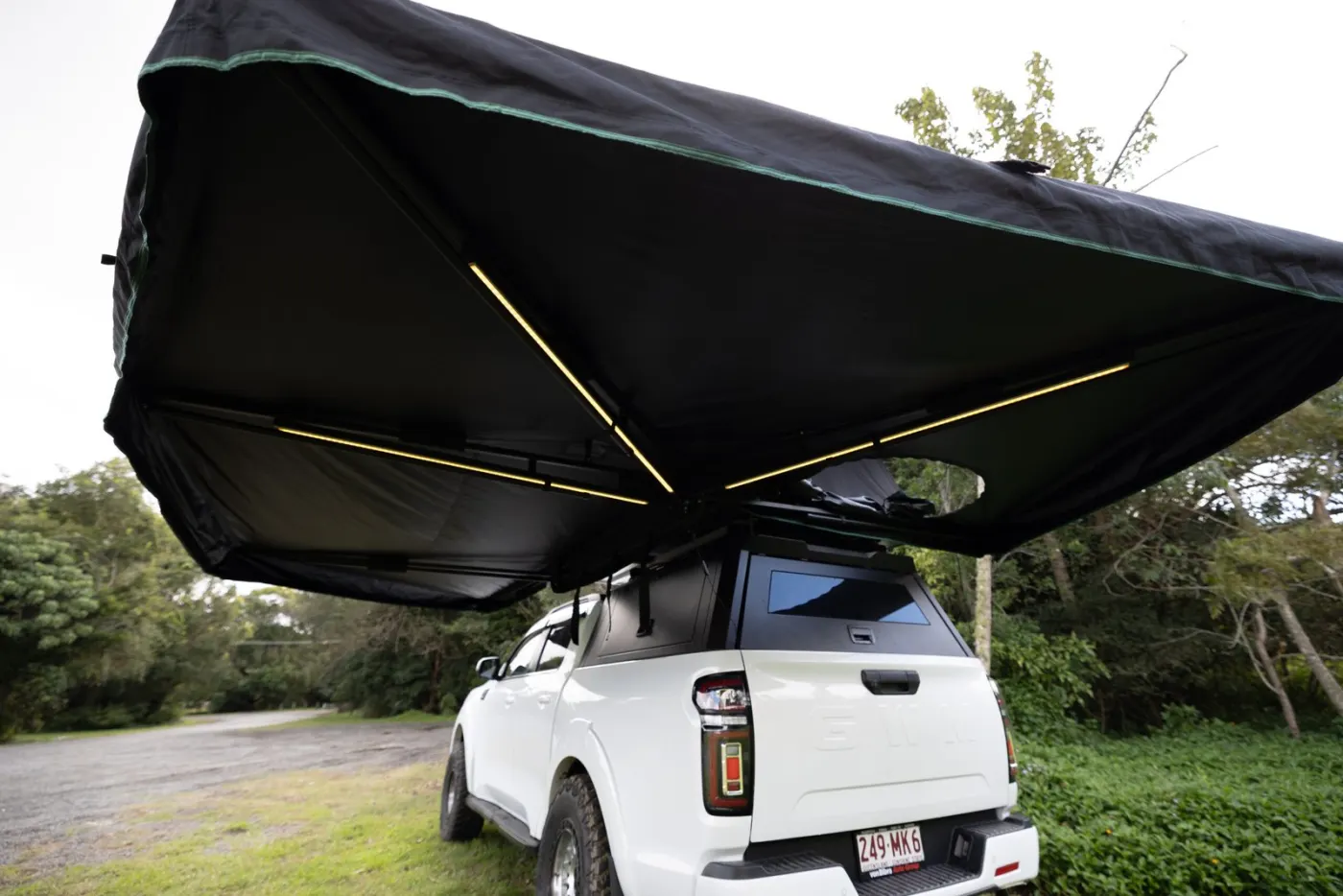
Your roof rack weight limit for a roof top tent comes down to two checks. While you drive, the tent plus the rack must weigh less than the lowest dynamic roof load rating (your vehicle's and your rack's). At camp, the tent, rack, bedding and everyone inside must weigh less than the static rating.
Get it wrong and you can bend crossbars, crack mounting points or lose the load on a rough track. Here is how each number works, where to find yours, and how to do the maths.
Why does the weight limit matter so much for a roof top tent?
A roof top tent is not like a surfboard or a kayak. Most hardshell roof top tents weigh roughly 55 to 85 kg before you add bedding. The RIGDUP Nomad 1.4M, for example, weighs 72 kg. Add two adults sleeping inside and the load at camp can pass 200 kg.
That is often fine when you are parked, if the static rating allows it. The real risk is driving. Braking, cornering and corrugations push much harder on the rack than the tent's weight sitting still. That is why the dynamic rating, the limit while moving, is the number that counts most.
What is dynamic roof load vs static roof load?
This is where most people get confused, so here is the plain version.
Dynamic roof load
This is the most weight your roof and rack can safely carry while the vehicle is moving. It allows for braking, cornering, speeding up and rough roads. It is the smaller of the two numbers, and the one people miss.
Static roof load
This is the most weight your roof and rack can hold when the vehicle is parked. With no driving forces, it is much higher than the dynamic rating. But there is no safe rule of thumb for how much higher. Use the static number the vehicle maker and rack maker publish.
For roof top tent camping you need to pass both checks:
- Driving to camp: the tent, the rack and anything else on the roof must stay within the dynamic rating
- Sleeping at camp: the tent, rack, bedding and people must stay within the static rating
What roof rack do you need for a rooftop tent?
Not all roof racks are built for a tent. Here are the common options for Australian 4WDs.
Factory roof rails and crossbars
Most 4WDs come with factory rails, but they are usually built for light loads. They are fine for a roof basket or a couple of surfboards, and often not strong enough for a roof top tent. If you plan to use factory rails, check the maker's rating first.
Heavy-duty aftermarket crossbars
Brands like Rhino-Rack, Yakima and Thule make heavier-duty bar systems that bolt to factory mounting points. Ratings vary by model and by vehicle, so check the exact listing for your car before you buy.
Full-length flat platform racks
A platform rack such as the Rhino-Rack Pioneer, ARB BASE Rack or Front Runner Slimline II spreads the weight over more mounting points. It is usually the strongest base for a tent, and it gives you room for other gear. Again, the rating depends on the model and your vehicle.
If you are fitting a roof top tent, do not skimp on the rack. It is the part that holds everything up.
What is the roof load limit on popular Australian 4WDs?
Every model, body style and year has its own roof load rating. The figure can also change when you fit an aftermarket rack. We have not listed numbers here, because a wrong number could put a tent on a roof that cannot carry it. Find your real figures in these places:
- Your owner's manual. Look for the roof load, roof rack or load carrying section.
- Your dealer or the vehicle maker's accessories page.
- The rack maker's fit guide for your exact vehicle. It lists the rack's dynamic and static ratings.
The Toyota Hilux, Ford Ranger, LandCruiser, Prado, Isuzu D-Max, Mitsubishi Triton and Nissan Patrol all have a published figure. Our guides to a roof top tent on a Toyota Hilux and a roof top tent on a Ford Ranger walk through those two.
Important: the rack's own weight counts toward the limit. If your platform rack weighs 25 kg, that 25 kg comes off the top before you add the tent.
How do you work out your total roof load?
Before you buy a roof top tent, do this simple sum:
- Find your vehicle's dynamic roof load rating in the owner's manual
- Find your rack's dynamic rating and use whichever of the two is lower
- Take away the weight of the rack (from the rack maker's specs)
- Take away the weight of the tent (from the tent specs)
- What is left is all you have for anything else on the roof
Example, using made-up round numbers (not a real vehicle):
- Lowest dynamic rating: 100 kg
- Platform rack: 22 kg
- Nomad 1.4M tent: 72 kg
- Left over: 6 kg
In that example the tent fits, with almost nothing to spare. If your dynamic rating is lower than your tent plus rack, the Nomad 1.4M is the wrong tent for that roof. Look at a lightweight roof top tent instead, or mount it on a canopy or tub rack with a higher rating.
How do you run a roof top tent safely on your 4WD?
Once you know your rack can handle the load, follow these tips on the road:
- Check all mounting bolts before every trip. Corrugated roads can shake bolts loose over time
- Keep the weight even. Centre the tent on the rack and don't offset it to one side
- Slow down on rough roads. The forces on the rack climb fast on corrugations, and the high load makes the vehicle less stable
- Check your GVM. Roof load is only one part of it. Your total weight (people, fuel, water and gear) must stay under the Gross Vehicle Mass
- Think about your suspension. Adding 60 kg or more to the roof raises your centre of gravity. Heavier springs or a GVM upgrade can help handling
- Never drive with the tent open or half closed. Close and latch it fully before you move
What tent and rack setups work well together?
Here are three common ways to set up a roof top tent in Australia. Each one still has to pass your weight check.
Light setup
Heavy-duty crossbars and a light tent. Suits utes and wagons with factory mounting points, as long as the numbers add up.
Platform setup
A platform rack, such as a Rhino-Rack Pioneer, with a hardshell like the Nomad 1.4M. It gives the tent a solid base and leaves room for light gear if your rating allows.
Touring setup
A platform rack, a hardshell tent and a 270° awning. Remember the awning adds weight too. The RIGDUP 270° Awning 2.5M weighs 27 kg and the 2M weighs 22 kg, so add it to your sum.
Frequently Asked Questions
Can I put a roof top tent on factory roof rails?
It depends on the vehicle and the rails. Some are rated high enough for a light tent, many are not. Check the rating in your owner's manual before you mount anything on factory rails.
What happens if I exceed my roof rack weight limit?
Going over the dynamic limit can bend or break crossbars, crack mounting points and, in bad cases, tear the rack off the vehicle. It is a serious safety risk, and damage it causes may not be covered by your warranty.
Do I need to upgrade my roof rack for a roof top tent?
Often, yes. Factory bars are built for light loads, and once you take off the rack's own weight there is often little left. A heavy-duty rack rated for your vehicle is the safer choice.
How much does a roof top tent weigh?
Most hardshell roof top tents weigh roughly 55 to 85 kg, depending on size and materials. Softshells are often lighter, around 40 to 60 kg, but bulkier when packed. The Nomad 1.4M hardshell weighs 72 kg.
What is the difference between roof load rating and rack load rating?
The roof load rating is set by the vehicle maker. It is the most the roof itself can carry. The rack load rating is set by the rack maker. It is what the rack can carry. You must stay within both, so the lower one is your limit.
Can I sleep in a roof top tent if my dynamic rating is low?
Often yes, because the static rating when parked is much higher. But you still need the tent and rack to fit under the dynamic rating to drive there, and the people and bedding to fit under the published static rating. Use the real numbers, not a guess.
Does adding a roof top tent affect my vehicle's handling?
Yes. Adding 60 kg or more to the roof raises your centre of gravity. That can change cornering, braking and stability on uneven ground. Think about a suspension upgrade and slow down on rough roads.
Which roof rack brands do people use for roof top tents in Australia?
Rhino-Rack, ARB, Front Runner and Yakima are common choices. Each one lists the ratings for each vehicle on its own website.
Which tent suits your roof?
Once you know your numbers, pick a tent that fits under them. The Nomad 1.4M hardshell roof top tent is a 72 kg clamshell for 2 adults, with cross bars and mounting brackets in the box. Not sure it suits your car? The RIGDUP fitting guide checks your vehicle and rack.