
Best Car Awnings for Australians in 2026: The Best Picks!

You’ve just pulled into camp after a long drive. The sun is already hammering down, and there’s not a tree in sight. That’s exactly where a good car awning earns its keep. The best car awnings for Australians in 2026 are:
- Rigup 270° Awning – Best all-in-one setup with built-in LED lights and ripstop poly-cotton canvas
- ARB Awning – Best premium pick for serious 4WDers
- Darche Eclipse Batwing – Best mid-range 270° coverage
- Ironman 4×4 Awning – Best value option for utes and SUVs
- Drifta 270° Awning – Best for long-haul overlanding and extended trips
Each one is built to handle brutal UV, gusty winds, and unpredictable Aussie weather. But the right choice depends on your vehicle, how you camp, and what you’re willing to spend. In this guide, you’ll find honest reviews, a clear breakdown of awning types, sizing advice, and our top picks for every budget.
What Is a Car Awning and Do You Actually Need One?
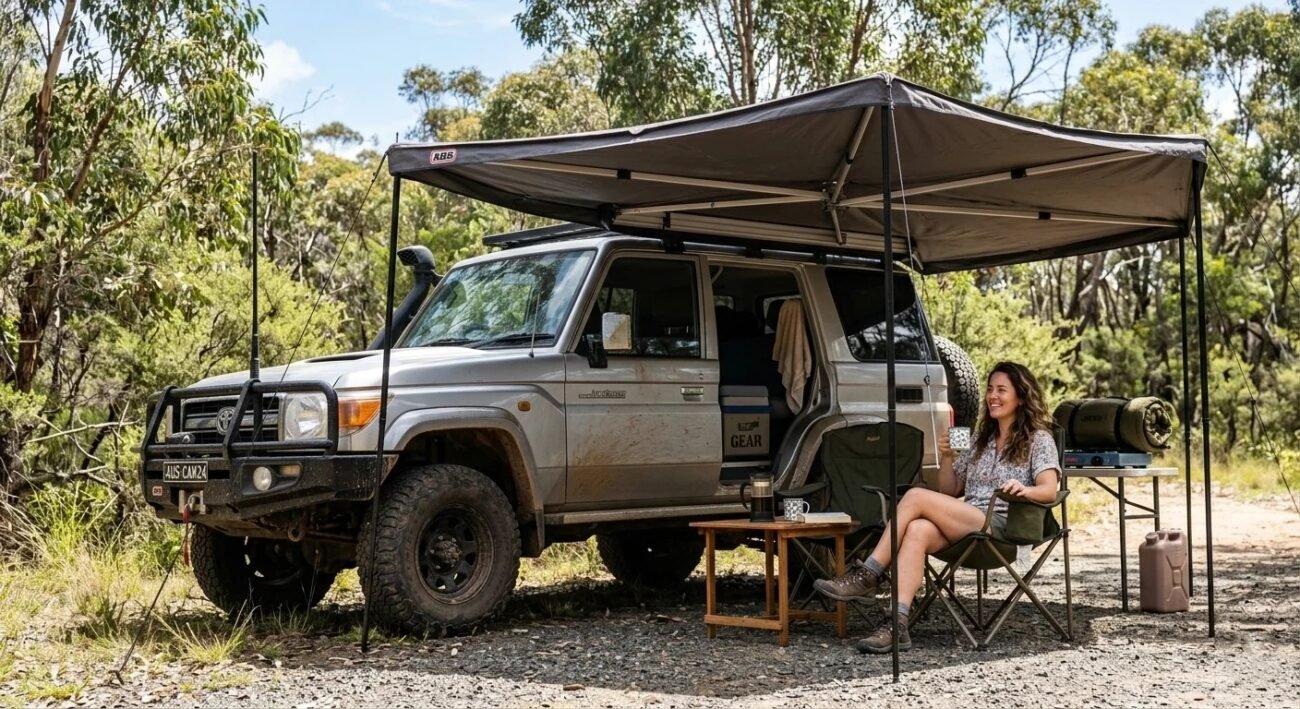
A car awning is a fabric shelter that mounts to your vehicle’s roof rack or rails. It unfolds outward to create instant shade and weather protection wherever you stop. Think of it as a portable veranda that travels with your car. Many Australians discover how much one transforms their camping setup after just one trip. Here is everything you need to know:
- It attaches to roof racks, side rails, or canopy sides on most 4WDs and utes
- It deploys in under five minutes, even when setting up alone
- It creates up to 15 square metres of usable shaded outdoor space
- It blocks harsh Aussie UV rays and provides cover during unexpected rain showers
- It suits camping, overlanding, beach days, work sites, and sporting events equally well
- It reduces interior vehicle heat when parked up in direct sunlight
- It pairs with zippered walls and mesh screens for fully enclosed shelter
- It is far more stable and practical than carrying a bulky freestanding gazebo
What Are the Different Types of Car Awnings?
Car awnings come in several distinct styles, and each suits a different type of traveller. Understanding the differences upfront saves you from buying the wrong setup. The wrong awning type causes real frustration at camp and often gets replaced within a season. Here is a clear breakdown of every major awning type available in Australia right now.
| Type | Coverage Area | Best For | Avg. Setup Time | Price Range (AUD) |
|---|---|---|---|---|
| 180° Side Awning | One vehicle side | Solo travellers, budget buyers | 2 to 3 mins | $200 to $600 |
| 270° Batwing Awning | Side and rear wrap | Families, base camps, overlanders | 3 to 5 mins | $600 to $1,800 |
| Tailgate Awning | Rear of vehicle only | Quick shade stops, smaller SUVs | 1 to 2 mins | $150 to $400 |
| Freestanding Awning | Detachable from vehicle | Extended stays, fixed campsites | 10 to 15 mins | $300 to $900 |
| Rooftop Awning | Overhead canopy layer | Rooftop tent users | 2 to 3 mins | $400 to $1,200 |
The 270° batwing is the most popular choice for Australians who camp regularly. The 180° side awning is the best starting point if you are on a tighter budget.
270° vs 180° Awning – Which One’s Better for Australians?
Choosing between a 270° and 180° awning comes down to how you actually use it at camp. Both work well, but they serve very different needs. Understanding these differences stops you from overspending or underbuying for your situation.
| Feature | 270° Batwing Awning | 180° Side Awning |
|---|---|---|
| Coverage Area | Wraps side and rear of vehicle | Covers one side only |
| Setup Time | 3 to 5 minutes | 2 to 3 minutes |
| Best For | Families, base camps, group cooking | Solo trips, quick stops, budget setups |
| Price Range (AUD) | $600 to $1,800 | $200 to $600 |
| Wind Resistance | Strong when guyed out properly | Good for lighter conditions |
| Packability | Bulkier when packed | Compact and easy to store |
| Wall Compatibility | Excellent, full enclosure possible | Limited wall attachment options |
I personally run a 270° batwing on my LandCruiser, and I would not go back. The rear coverage alone changes everything when cooking or sitting out in the evening. My whole camp kitchen fits comfortably under it, rain or shine. For me, the extra cost is completely justified by what you actually get at camp.
What Size Car Awning Do You Actually Need?
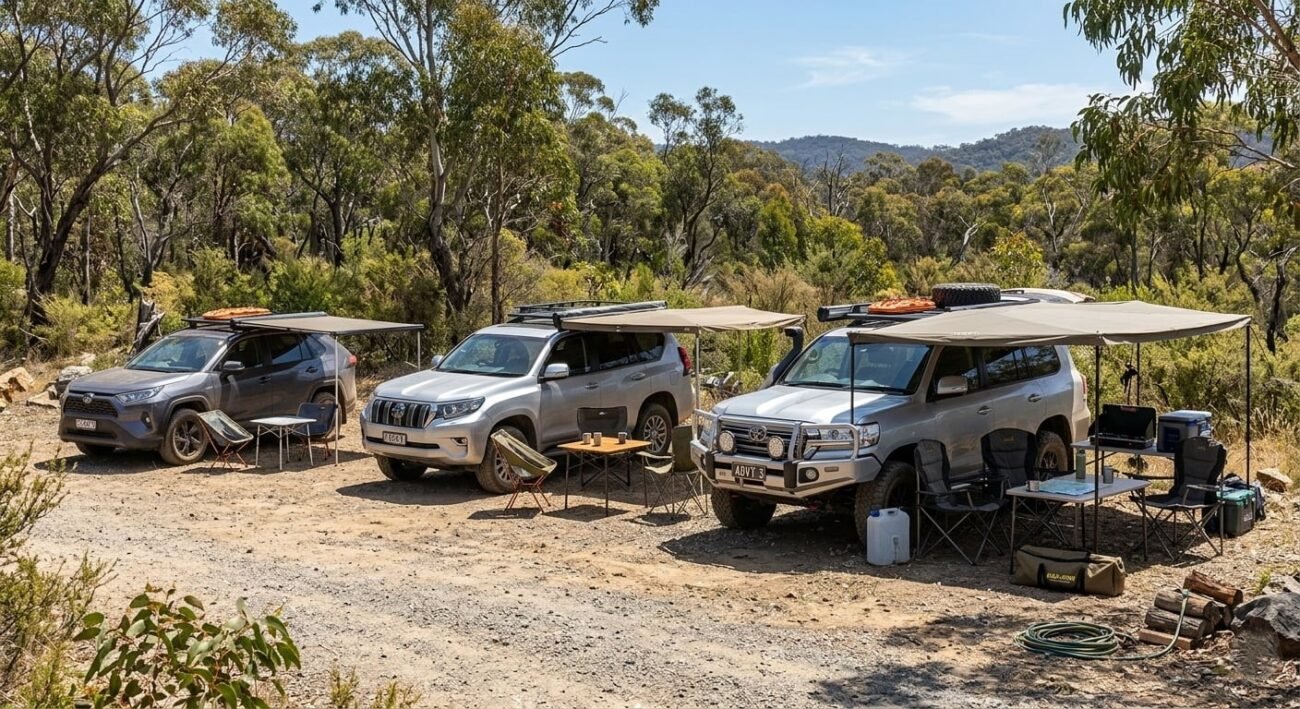
Size matters more than most buyers realise before their first purchase. Getting the wrong size means either not enough shade or a dangerous overhang past your vehicle. The right size depends on your vehicle length, group size, and how you camp.
For most utes and mid-size SUVs, a 2.0m to 2.5m awning hits the sweet spot. It covers your cooking area, camp chairs, and gear without being awkward in tight campsites. If you drive a full-size 4WD like a 200 Series or 300 Series LandCruiser, a 2.5m to 3.0m awning gives proper coverage. Going bigger than your vehicle length creates wind-catch problems and stresses your roof rack mounts.
Families generally benefit from the larger end of the size range. Solo travellers and couples manage well with a 2.0m to 2.5m option. Always measure your roof rack spread before buying, not just your vehicle length. Rack placement directly affects how the awning sits and deploys on your specific setup.
What Are the Best Car Awning Brands in Australia Right Now?
Australia has a strong market for car awnings, with several brands standing out for real-world reliability. Not every brand holds up equally against outback dust, coastal humidity, and relentless UV exposure. Here are the top brands worth your attention right now.
| Brand | Starting Price (AUD) | Why It Stands Out | Best For |
|---|---|---|---|
| Rigdup | $1,700 | 280gsm ripstop poly-cotton canvas, full alloy A-frame, built-in LED lights, 270° coverage | Overlanders wanting a complete ready-to-use setup |
| ARB | $600 | Long track record, wide dealer network, excellent build quality | Serious 4WDers who want proven reliability |
| Darche | $450 | Great mid-range pricing, solid UV protection, popular across Australia | Weekend campers and families |
| Ironman 4×4 | $380 | Wide vehicle fitment, good warranty support, accessible pricing | Budget-conscious buyers with utes or SUVs |
| Drifta | $750 | Strong reputation in overlanding circles, quality hardware and stitching | Long-haul travellers doing extended trips |
Rigdup brings a genuinely complete package at its price point. The built-in LED lighting and ripstop canvas construction set it apart from most competitors at a similar level. Worth considering if you want a serious setup without sourcing extra accessories separately.
What’s the Best Car Awning Under $500?
Spending under $500 on a car awning is completely achievable, and a solid functional setup is possible at this price. The trade-off is usually canvas thickness, frame materials, and fewer included accessories. Knowing what matters most at this budget helps you pick the right one without regret.
| Brand | Model | Price (AUD) | Canvas Weight | Coverage | Best For |
|---|---|---|---|---|---|
| Ironman 4×4 | Adventure Awning | $380 | 240gsm | 180° | Utes and mid-size SUVs |
| Darche | Eclipse 180 | $449 | 240gsm | 180° | Weekend campers |
| Ridge Ryder | Side Awning 2.0m | $199 | 210gsm | 180° | Occasional use, tight budgets |
| Bushranger | Awning 2.5m | $420 | 230gsm | 180° | General camping and touring |
| OzTrail | Car Awning | $299 | 210gsm | 180° | Beginners and casual campers |
At this budget, expect 180° coverage across the board. That is perfectly fine for most weekend trips and casual camping. The Ironman 4×4 and Darche options are the strongest performers under $500 for material quality and durability. But avoid going below $500 if you plan to use your awning in strong wind or coastal conditions regularly.
What’s the Best Mid-Range Car Awning ($500–$1,000)?
The $500 to $1,000 range is where car awnings genuinely start performing at a high level. You get noticeably better canvas weight, stronger frame materials, and proper wind resistance. Most serious weekend campers and touring families land right here, and it is easy to see why. The jump in quality from the budget tier is immediately obvious when you set one up at camp.
| Brand | Model | Price (AUD) | Canvas Weight | Coverage | Best For |
|---|---|---|---|---|---|
| Darche | Eclipse 270 Batwing | $699 | 260gsm | 270° | Families and base camps |
| Ironman 4×4 | 270° Batwing Pro | $649 | 250gsm | 270° | Utes and large SUVs |
| ARB | Awning 2.5m | $599 | 240gsm | 180° | Proven reliability seekers |
| Drifta | 270° Batwing | $849 | 270gsm | 270° | Long-haul overlanders |
| Bushranger | Batwing Awning | $599 | 250gsm | 270° | Budget-conscious tourers |
At this price point, the 270° batwing becomes genuinely accessible. Darche and Drifta deliver the strongest overall packages for the money in this range.
What’s the Best Premium Car Awning If You’re Going All-Out?
Premium awnings are not just about better looks. The difference shows up in the field through stronger frames, heavier canvas, and features that make daily camp life genuinely easier. If you travel regularly or spend extended time outback, a premium awning pays for itself through longevity and performance. Cutting corners here often means replacing a cheaper awning within two seasons.
| Brand | Model | Price (AUD) | Canvas | Key Feature | Best For |
|---|---|---|---|---|---|
| Rigdup | 270° Awning | $1,700 | 280gsm Ripstop Poly-Cotton | Built-in LED lights, full alloy A-frame, heavy-duty D-zippers | Overlanders wanting a complete ready-to-use setup |
| ARB | Batwing Awning 2.5m | $1,199 | 260gsm | Dealer network, proven outback reliability | Serious 4WD tourers |
| Darche | Eclipse 270 PRO | $1,099 | 270gsm | Full wall compatibility, quality hardware | Family overlanders |
| Drifta | 270° Premium | $1,350 | 280gsm | Superior stitching, robust arm joints | Extended trip travellers |
Rigdup stands out at the top end by including LED lighting and ripstop canvas construction as standard. That is real value without sourcing accessories separately.
Which Car Awning Is Easiest to Set Up Solo?
Solo setup is a real concern that many buyers overlook until they are standing at camp alone. A heavy or poorly designed awning becomes genuinely frustrating without a second person. The right design makes a big difference when you are tired after a long drive. Here is what makes an awning genuinely solo-friendly:
- Lightweight aluminium frames under 15kg deploy without straining your back or shoulders
- Gas-assisted or spring-loaded arms open with a single push instead of manual lifting
- Clearly marked attachment points speed up the process significantly in low light
- Simple two-point mounting systems are far faster than complex bracket arrangements
- Integrated velcro straps and buckles keep fabric controlled during deployment
- Quality zippers on the bag open smoothly and do not catch or jam mid-setup
- Colour-coded poles or integrated storage reduce fumbling at the end of a long drive
- 180° side awnings generally deploy faster solo than larger batwing designs
Darche and Ironman 4×4 consistently receive strong feedback from solo travellers for their straightforward deployment systems.
Which Awning Best Handles Harsh Aussie Conditions?
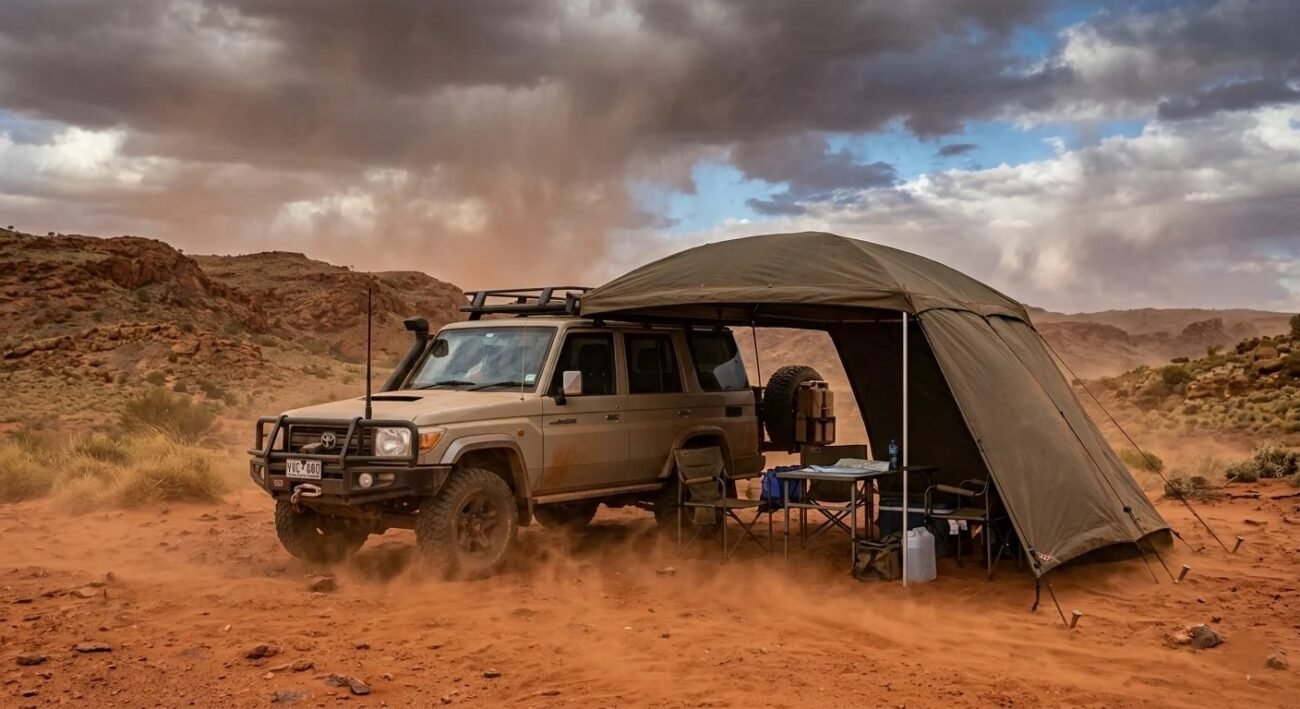
Australian conditions genuinely test gear in ways that European or American camping equipment is never designed for. Extreme UV, red dust, coastal salt air, and sudden wind gusts expose every weakness in a poorly made awning. Canvas weight, frame strength, and zipper quality are the three things that separate a lasting awning from a replacement purchase. Here are the specific features that matter most:
- Canvas rated at 260gsm or above resists UV breakdown and tearing in prolonged sun exposure
- Ripstop weave construction, like Rigdup’s 280gsm canvas, prevents small tears from spreading across the fabric
- Full aluminium A-frame designs handle wind loading far better than steel or mixed-material frames
- Heavy-duty D-zippers resist salt corrosion and dust ingress far better than standard zippers
- Integrated rain runoff poles channel water away cleanly without pooling on the canvas
- UPF 50+ rated fabric is the minimum acceptable standard for genuine Australian sun protection
- Sealed seams prevent water entry during coastal downpours and tropical wet season storms
- Rigdup’s built-in LED system eliminates the need for external lighting exposed to weather conditions
Always guy out your awning in any wind above 20km/h regardless of the brand you choose.
Do You Need a Roof Rack to Fit a Car Awning?
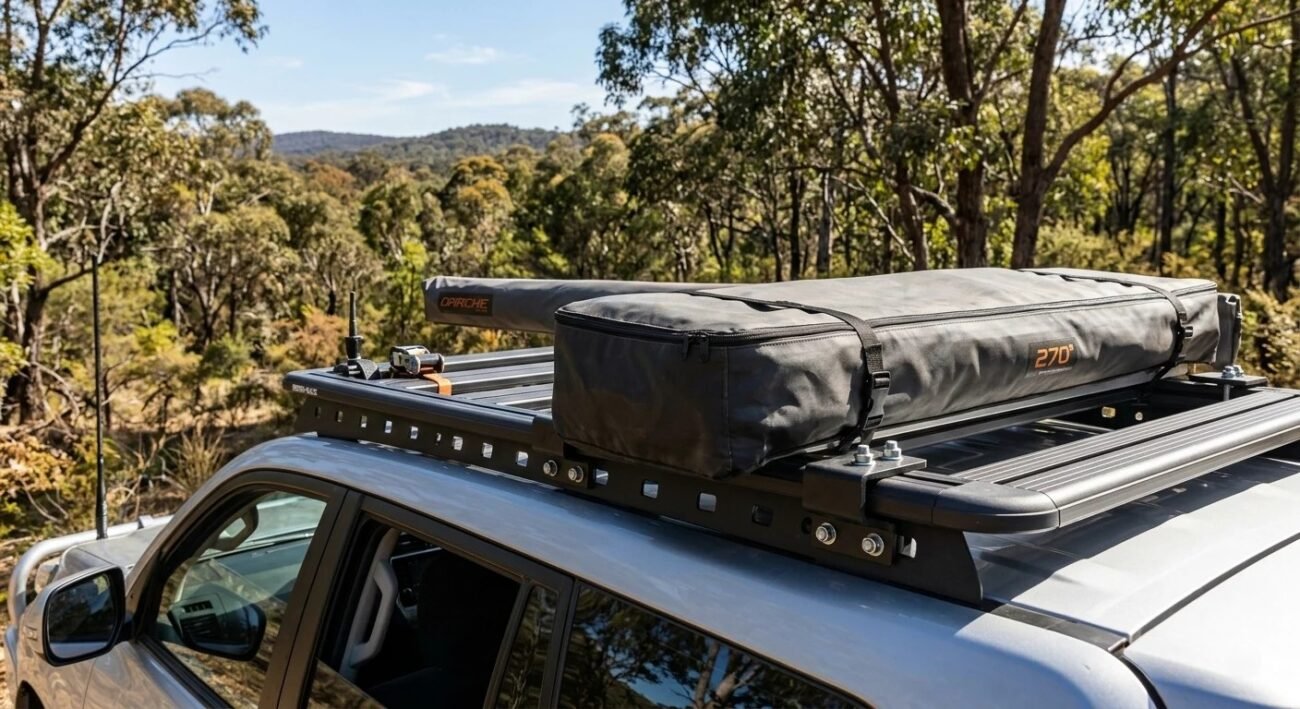
Most car awnings need some form of raised mounting point to attach correctly to your vehicle. A flat roof with no rack makes proper installation very difficult and often unsafe. The awning needs clearance above the roofline so it deploys outward without scraping your paintwork or glass.
A traditional roof rack is the most common and reliable mounting solution. Brands like Rhino-Rack, Thule, and ARB offer rack systems specifically designed to handle awning loads and wind force at highway speeds. Most awnings clamp directly onto the rack’s crossbars using universal mounting brackets. Always check the load rating of your rack before fitting any awning, especially a heavy 270° batwing.
That said, several modern awnings are designed for direct rail mounting without a full rack. These suit vehicles with factory-fitted flush rails or low-profile tracks. Canopy-mounted awnings are also growing in popularity among ute owners in Australia.
The canopy provides a solid, purpose-built mounting surface without needing a separate rack system. Whatever mounting method you choose, torque your bolts correctly and check them after the first highway drive.
What’s the Best Awning for a Ute, 4WD, or SUV?
Choosing an awning based on your vehicle type is one of the most overlooked steps in the buying process. A setup that works perfectly on a LandCruiser can look and perform poorly on a small SUV. Getting the right match means better coverage, cleaner aesthetics, and safer mounting. Here is a clear breakdown by vehicle type.
| Vehicle Type | Recommended Size | Coverage | Top Pick | Key Benefit |
|---|---|---|---|---|
| Ute (HiLux, Ranger, BT-50) | 2.0m to 2.5m | 270° Batwing | Ironman 4×4 270° | Canopy-compatible mounting, excellent camp kitchen coverage |
| Large 4WD (LandCruiser, Patrol, Prado) | 2.5m to 3.0m | 270° Batwing | Drifta or ARB Batwing | Matches vehicle length, handles weight well |
| Mid-Size SUV (Fortuner, Everest, MUX) | 2.0m to 2.5m | 180° or 270° | Darche Eclipse 270 | Balanced coverage without overhanging the vehicle |
| Small SUV (RAV4, Forester, CX-5) | 1.8m to 2.0m | 180° Side Awning | Darche or Bushranger | Lightweight, suits lower rack load ratings |
Always verify your roof rack’s load rating before committing to a larger batwing on smaller vehicles.
Do Car Awning Walls or Rooms Actually Make a Difference?
Awning walls transform a basic shade structure into a fully functional outdoor shelter. Most buyers only consider walls after their first rainy night or bug-heavy campsite. Adding walls changes what is possible at camp in ways that are immediately obvious. The right wall type depends entirely on your camping style and the conditions you regularly face.
| Wall Type | Best Conditions | Key Benefit | Compatible Awning Type | Approx. Price (AUD) |
|---|---|---|---|---|
| Solid Side Wall | Rain, wind, dust | Full weather block, privacy | 180° and 270° awnings | $80 to $180 |
| Mesh Side Wall | Summer, coastal, tropical | Bug protection, airflow maintained | 180° and 270° awnings | $70 to $150 |
| Full Enclosure Room | Cold nights, extended stays | Complete enclosed living space | 270° batwing primarily | $250 to $600 |
| Rear Wall Panel | Dust, afternoon sun | Targeted coverage behind vehicle | 270° batwing | $60 to $140 |
Walls designed specifically for your awning brand always fit and seal better than generic options. Always buy brand-matched walls where possible.
What Do Real Buyers Wish They Knew Before Buying?
I have spoken with a lot of buyers over the years, and several patterns come up constantly. My close friends who are into overlanding always ask me the same questions after their first purchase. Most of their regrets are completely avoidable with the right information upfront. Here is what they consistently wish someone had told them earlier.
I always hear “I wish I had bought a bigger size” from people who went conservative. Camp setups naturally expand once you have shade, and extra space always gets used. My mate Dave bought a 180° for his family of four and replaced it within one season. He now runs a 270° batwing and has never looked back.
Several friends also mentioned they never checked pole and joint quality before buying. Arm joints are the first thing that fails on cheaper awnings under repeated use. Canvas quality matters, but a bent or cracked arm at a remote campsite is a far bigger problem. Always physically inspect or research the frame hardware before committing to any awning purchase.
How Do You Look After a Car Awning So It Lasts?
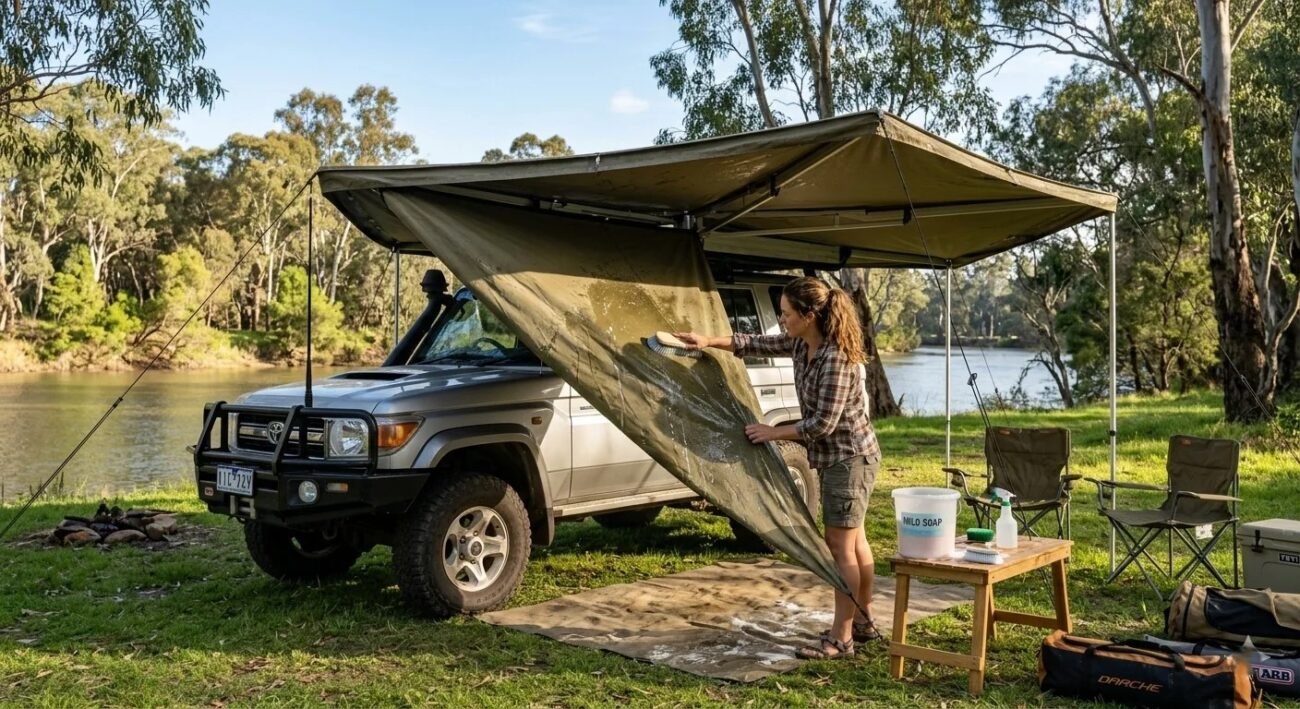
Maintenance is the difference between an awning that lasts three years and one that lasts ten. Most damage happens not during use, but during storage when the awning is packed away damp or dirty. A few simple habits after each trip dramatically extend the life of your canvas, zippers, and frame. Getting this right from day one saves you money and frustration long-term.
Always let your awning dry completely before rolling it back into the bag. Packing it away even slightly damp creates mould within days, especially in humid coastal areas of Queensland and Western Australia. If you cannot dry it at camp, unpack it at home and let it air out fully before storing it again.
Clean the canvas every few trips using a soft brush and mild soapy water. Avoid harsh detergents because they strip the waterproof coating from the fabric surface. Lubricate arm joints and pivot points with a dry silicone spray every few months.
Check mounting bolts after every highway drive and retighten anything that has worked loose. Store the packed awning away from direct sunlight to prevent UV damage to the bag itself.
So, Which Car Awning Should You Buy in 2026?
After everything covered in this guide, the right awning comes down to three things: your vehicle, how often you camp, and what experience you want at camp. Budget options work fine for occasional use. Mid-range awnings suit most weekend and touring campers.
But if you are serious about your setup and want something that genuinely performs without compromise, the premium tier is where the real difference shows.
I have used a lot of awnings over the years across different vehicles and conditions. The ones that keep impressing me are the ones built with heavier canvas, solid alloy frames, and practical features that actually get used at camp.
When my friends ask me what I would personally buy right now if I were starting fresh, I point them toward the Rigdup 270° Awning. The 280gsm ripstop poly-cotton canvas, full aluminium A-frame, built-in LED lighting, and heavy-duty D-zippers give you a genuinely complete setup straight out of the box.
It sits at $1,700, which is a real investment, but you are not piecing together accessories afterwards. For anyone planning regular trips across Australia in 2026, that combination of features and build quality is hard to look past. See all our Roof Top Tent Comparisons & Reviews in one place – here.
FAQs
Some modern awnings mount directly to factory roof rails or ute canopies without a full rack. Always check your vehicle’s rail type and load rating first. Purpose-built canopy mounts are a popular option for ute owners across Australia who want a clean, rack-free setup.
A well-maintained awning with 260gsm or heavier canvas typically lasts seven to ten years. Regular cleaning, proper drying before storage, and silicone lubricant on the joints all extend lifespan significantly. Cheaper awnings with lighter canvas usually show UV wear and seam failure within two to three seasons.
UPF 50+ is the minimum rating you should accept for any awning used in Australia. Anything below that lets through too much UV radiation, especially in summer. Most mid-range and premium awnings meet UPF 50+ as a standard specification rather than an optional upgrade.
If you camp regularly with family or set up a full kitchen at camp, a 270° batwing is absolutely worth it. The rear and side coverage creates a genuinely usable outdoor room. Solo travellers and occasional campers generally get everything they need from a quality 180° side awning at lower cost.
The Toyota HiLux suits a 2.0m to 2.5m awning mounted to a canopy or roof rack. The Ironman 4×4 270° Batwing and Darche Eclipse 270 are both popular choices among HiLux owners. Both fit standard rack setups and provide enough coverage for a comfortable camp kitchen and sitting area.
Check that your awning has integrated rain runoff poles and sealed seams. Set a slight angle on the awning so water runs off rather than pooling. Re-treating the canvas with a waterproofing spray like Nikwax or similar every one to two years also helps maintain water resistance significantly.
Most manufacturers recommend using all guy ropes and pegs in winds above 20km/h. High-quality aluminium A-frame awnings handle moderate wind better than lighter designs. Rolling your awning in during sustained strong wind is always the safer choice to protect both the awning and your roof rack mountings.