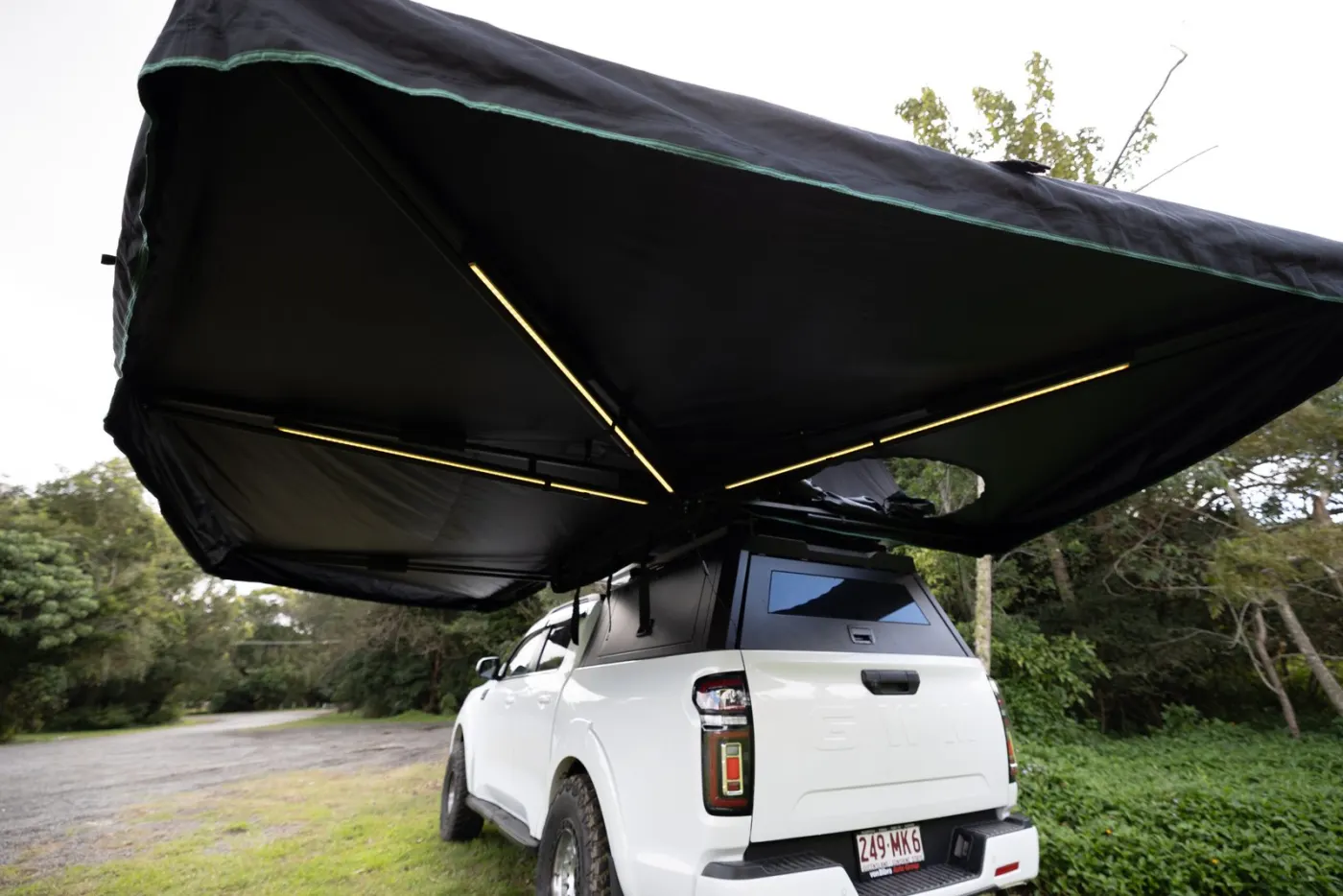
The lightest roof top tent for you is usually a soft shell fold-out or a small hard shell, but weights vary a lot, so check the listed weight against your vehicle’s roof load. Most hard shells weigh 50 kg or more, and the weight that matters is the tent, rack and gear added together.
RIGDUP’s Nomad 1.4M weighs 72 kg, so it is not a lightweight tent. If your roof rating is low, pick something lighter. If weight matters most, these tents are worth a look:
- Darche Panorama 1400: a soft shell fold-out from an Australian brand.
- Kings Grand Tourer Sports Lite: Kings lists it as a lightweight, low profile aluminium hard shell.
- iKamper Skycamp 3.0 Mini: a compact hard shell, listed by iKamper at 56 kg.
This guide covers what counts as lightweight, how to check your roof load, hard shell vs soft shell weight, and how to pick a tent that suits your rig.
What Makes a Roof Top Tent Truly “Lightweight”?
“Lightweight” gets used a lot in roof top tent ads. There is no official cut-off, but a few things decide how much weight ends up on your roof:
- The type of tent matters most. Kings’ hard shell page puts most hard shells at 50 to 80 kg, so a tent well under that counts as light.
- Base material makes a difference. Aluminium honeycomb bases are stiff for their weight.
- Canvas weight is a trade-off. Heavier canvas lasts longer in the sun but adds weight. 280 to 320gsm poly-cotton is a common middle ground.
- Packed height matters as a tall closed tent adds wind drag on long drives.
- The dynamic load rating is the limit while driving. It does not change, so a heavier tent leaves less room for everything else.
- The ladder is often forgotten, and it adds a few kilos.
- Mounting hardware, like cross bars, also counts toward your total roof load.
Always add up the full setup, not just the tent.
Which Lightweight Roof Top Tents Suit Australian Conditions?
Heat, UV, red dust, corrugations and long distances are hard on gear. Here is how a few tents compare. Specs come from each brand’s site, so check them before you buy.
| Tent | Type | Listed Weight | Good to Know |
|---|---|---|---|
| Darche Panorama 1400 | Soft shell fold-out | Check Darche’s site | Australian brand with local dealers |
| Kings Grand Tourer Sports Lite | Aluminium hard shell | Check Kings’ site | Kings calls it lightweight and low profile, with a 25 second set-up (Kings hard shell range, checked October 2026) |
| iKamper Skycamp 3.0 Mini | Hard shell | 56 kg (iKamper Skycamp Mini page, checked October 2026) | Compact shell for smaller roofs |
| RIGDUP Nomad 1.4M | Clamshell hard shell | 72 kg | Not a lightweight tent. 255W solar panel, 70mm memory foam and cross bars included. Pick it only if your roof and rack can carry it. |
Check that any tent you buy has local support. It matters when you are 500 km from the nearest town.
Hard Shell vs Soft Shell - Which One Is Actually Lighter?
Most people assume a soft shell always wins on weight. It often does, but not always, so compare the listed weights.
| Feature | Hard Shell | Soft Shell |
|---|---|---|
| Typical Weight | Often 50 to 80kg | Often 30 to 55kg |
| Shell Material | Aluminium, fibreglass or ABS plastic | Poly-cotton canvas or ripstop nylon |
| Setup Time | 30 to 60 seconds | 2 to 5 minutes |
| Packed Height | Low profile, better aerodynamics | Bulkier when folded |
| Dust Resistance | Good, with a sealed shell | Moderate, depends on the cover and zips |
| Price Range (AUD) | $1,500 to $4,000+ | $800 to $2,500 |
| Best For Australia | Outback, dusty tracks, moving camp often | Budget travellers, lighter vehicles |
Prices are a rough guide from early 2026. Check each brand’s site for today’s price.
Soft shells are often lighter, which helps on a vehicle with a low roof rating. Hard shells keep dust off your bedding and pack away faster. Our hard shell vs soft shell roof top tent guide compares them in full.
How Do You Know If a Roof Top Tent Is Safe for Your Vehicle’s Roof?
Your vehicle has two roof load ratings, and many buyers only check one.
- Static load rating is the weight your roof holds while the vehicle is parked.
- Dynamic load rating is the limit while the vehicle is moving, and it is much lower.
- The dynamic rating is the one that matters when you drive with a tent on the roof.
- Total roof load includes the tent, rack, cross bars and any gear on top.
- Cross bar spacing must meet the tent maker’s minimum.
- Your rack has its own rating. Stay under the lower of the rack and roof ratings.
- Check your owner’s manual for the exact roof load rating before you buy.
Our guide to roof rack weight limits for roof top tents shows how to add it all up. Getting this wrong is a safety risk every time you drive.
What’s a Fair Price for a Quality Lightweight Roof Top Tent in Australia?
Prices vary a lot, and cheap tents can cost more over time through repairs and replacements.
Budget tier (under $1,200 AUD) gets you a basic soft shell with thinner canvas and simpler zips. Setup is slower. These suit occasional weekend campers on lighter vehicles.
Mid-range ($1,200 to $2,500 AUD) is where many Australians find good value. Canvas, zips and bases improve. This tier handles regular use well.
Premium ($2,500 to $4,000+ AUD) covers most hard shells, including the Nomad 1.4M. It comes with an aluminium honeycomb base, a 70mm memory foam mattress, YKK zips, a 255W solar panel and cross bars in the box. See the Nomad 1.4M page for today’s price.
Tents bought from overseas can look cheaper online. Add shipping, import costs and no local warranty, and the savings can disappear.
Which Roof Top Tent Brands Support Customers in Australia?
Local support matters when you have a warranty issue 600 km from the nearest city.
| Brand | Origin | Australian Support | Known For |
|---|---|---|---|
| RIGDUP | Australia | Gold Coast workshop and phone support, 2 year warranty | Clamshell hard shells with solar included |
| Darche | Australia | Nationwide dealers | Soft shell and hard shell tents |
| Kings (4WD Supacentre) | Australia | Company stores in NSW, QLD, VIC, WA, SA and the ACT | Budget-friendly tents, spare parts sold online |
| iKamper | South Korea | Check for a local stockist | Compact hard shells |
| Thule | Sweden | Authorised Aussie dealers | Build quality, roof rack fit |
Brands without local support are a risk, because warranty claims can mean shipping parts overseas. Check each brand’s warranty and service before you buy.
How Quick Is the Setup - Can You Really Do It Alone?
Ads show perfect setups on flat ground in good light. Here is what solo setup looks like step by step on a tired Friday night.
Step 1: Park on reasonably level ground and put the handbrake on before you climb up.
Step 2: Undo the cover straps or release the hard shell latches.
Step 3: Push the shell open or unfold the soft shell until it is fully out.
Step 4: Extend the ladder and lock it at a safe angle.
Step 5: Lay the mattress flat. Memory foam may need a few minutes to expand.
Step 6: Add any annex panels or mosquito nets if you are staying more than one night.
Most hard shells get through Steps 1 to 5 solo in a couple of minutes. The Nomad 1.4M is up in about 60 seconds with no tools, and the bedding can stay inside. Soft shells take closer to five minutes once you unfold the panels and set the ladder.
How Well Do Lightweight Tents Handle Australian Heat and UV?
Australia’s UV index often hits 11 and above, and outback summers can pass 45 degrees Celsius. Check that any tent you buy is made for those conditions.
Canvas weight affects heat. Ripstop poly-cotton canvas, like the 320gsm canvas on the Nomad 1.4M, breathes better than cheap nylon under direct sun. Thin nylon traps heat and breaks down faster in strong UV.
Ventilation matters just as much. Mesh windows on opposite sides let air flow through and cool the tent. Without that, a closed tent in Queensland sun gets hot by mid-morning.
Condensation is a real problem in humid places like Cairns or Darwin. Poly-cotton canvas soaks up and lets go of moisture, which cuts the wet ceiling problem nylon tents often have overnight.
UV damage builds up. Cheap canvas loses waterproofing and strength after a few seasons in the Australian sun. Quality canvas with UV-stable thread and a good waterproof rating lasts longer.
What Accessories Make a Lightweight Roof Top Tent More Liveable?
A bare roof top tent gets you off the ground. The right extras make camp more comfortable.
| Accessory | Approx. Price (AUD) | Usage |
|---|---|---|
| Annex Room | $200 to $600 | Creates sheltered ground-level living and changing space |
| Mattress Topper (Memory Foam Upgrade) | $80 to $200 | Adds comfort for cold nights or longer trips |
| 12V LED Strip Lighting | $30 to $80 | Interior lighting that uses little battery |
| Insulated Liner / Thermal Blanket | $100 to $250 | Reduces heat in summer and cold in alpine conditions |
| Solar Blanket or Panel Mount | $150 to $400 | Charges devices without running the engine |
| Waterproof Gear Bag (Under-Tent) | $60 to $120 | Stores shoes, wet gear and muddy camp items |
| Mosquito Net Extension | $40 to $90 | Useful for tropical Queensland, the Northern Territory and coastal camping |
| Anderson Plug Extension Lead | $25 to $60 | Connects tent power to the vehicle battery |
Accessories add weight too, so check them against your roof load rating. An annex sits on the ground, but anything packed inside the tent counts.
What Are the Most Common Roof Top Tent Mistakes Australians Make?
Most of these are easy to avoid with a bit of planning.
- Ignoring the dynamic load rating is the most dangerous mistake. Static ratings look generous until you hit corrugations at 80km/h.
- Getting the cross bar spacing wrong can make the tent base flex and crack over time. Check the tent maker’s minimum spacing.
- Skipping a test setup at home means your first real try happens in the dark after a long drive.
- Not re-waterproofing canvas leads to leaks that feel random but are preventable.
- Choosing a tent by weight alone without checking packed height can cause clearance problems in car parks.
- Leaving zips open in rain lets water run along the zip teeth and drip inside.
- Storing the tent damp is the fastest way to grow mould in canvas.
- Buying from overseas sellers with no local warranty turns a small repair into a big problem.
Fix these before your first trip, not after your first problem.
How Do You Maintain a Lightweight Tent So It Lasts Outback Trips?
Good care is simple. It is mostly small habits after every trip.
- Dry the tent completely before packing it away, every time.
- Brush red dust off the canvas before folding so it does not wear the fabric.
- Clean canvas with mild soap and cool water only. Harsh detergents strip the waterproofing.
- Never use a high-pressure hose on canvas seams as it forces water through the stitching.
- Lubricate zips with a dry zip lubricant every few trips to stop them sticking.
- Check hinge points and mounting bolts after every trip on unsealed roads.
- Re-treat the canvas waterproofing once a year with a product made for poly-cotton canvas, ideally before the wet season.
- Check the ladder’s rubber feet as they crack in UV and can scratch paint.
- Store the tent somewhere with airflow rather than a sealed shed, so moisture does not build up.
Which Lightweight Roof Top Tent Is Right for Your Setup?
There is no single perfect tent for everyone. The choice gets simple when you match the tent to your vehicle honestly.
If you drive a compact SUV with a low roof rating, put weight first and look at light soft shells. If budget comes first, the Kings range is worth a look. Our guide to the best roof top tents in Australia compares more options.
If your 4WD or ute can carry 72 kg plus the rack, the Nomad 1.4M gives you a 70mm memory foam mattress, a 255W solar panel and a power socket with USB-C, USB-A and 12V, with cross bars in the box.
Check your vehicle with the RIGDUP fitting guide first. If it passes, see the Nomad 1.4M roof top tent.
FAQs
What is the lightest rooftop tent available in Australia right now?
There is no single answer, because weights change between models and years. Soft shell fold-outs are often the lightest. Compact hard shells like the iKamper Skycamp 3.0 Mini sit around 56 kg, and RIGDUP’s Nomad 1.4M is 72 kg. Always check the full weight, including the ladder and mounting hardware.
Can I put a rooftop tent on a Toyota RAV4 or similar crossover SUV?
Often, but check the dynamic roof load rating in the owner’s manual first. Small SUVs are often rated lower than big 4WDs. The tent, rack, cross bars and any gear must all fit under that rating, so a light tent and a light rack matter.
Is a rooftop tent worth it for Australian camping compared to a ground tent?
For outback and remote camping, many people think so. You sleep away from snakes, spiders and wet ground, and setup is faster. For short weekend trips close to home, a good ground tent is better value.
How long does a quality rooftop tent last in Australian conditions?
With good care, a quality tent can last many years. UV damage and zip failure are the most common reasons tents wear out early. Re-waterproofing and zip care help a lot.
Do rooftop tents damage your car roof or roof rack over time?
A properly mounted tent on a rack rated for it should not cause damage in normal use. Problems happen when cross bar spacing is wrong, load limits are exceeded or bolts work loose. Check your mounting hardware every few trips.