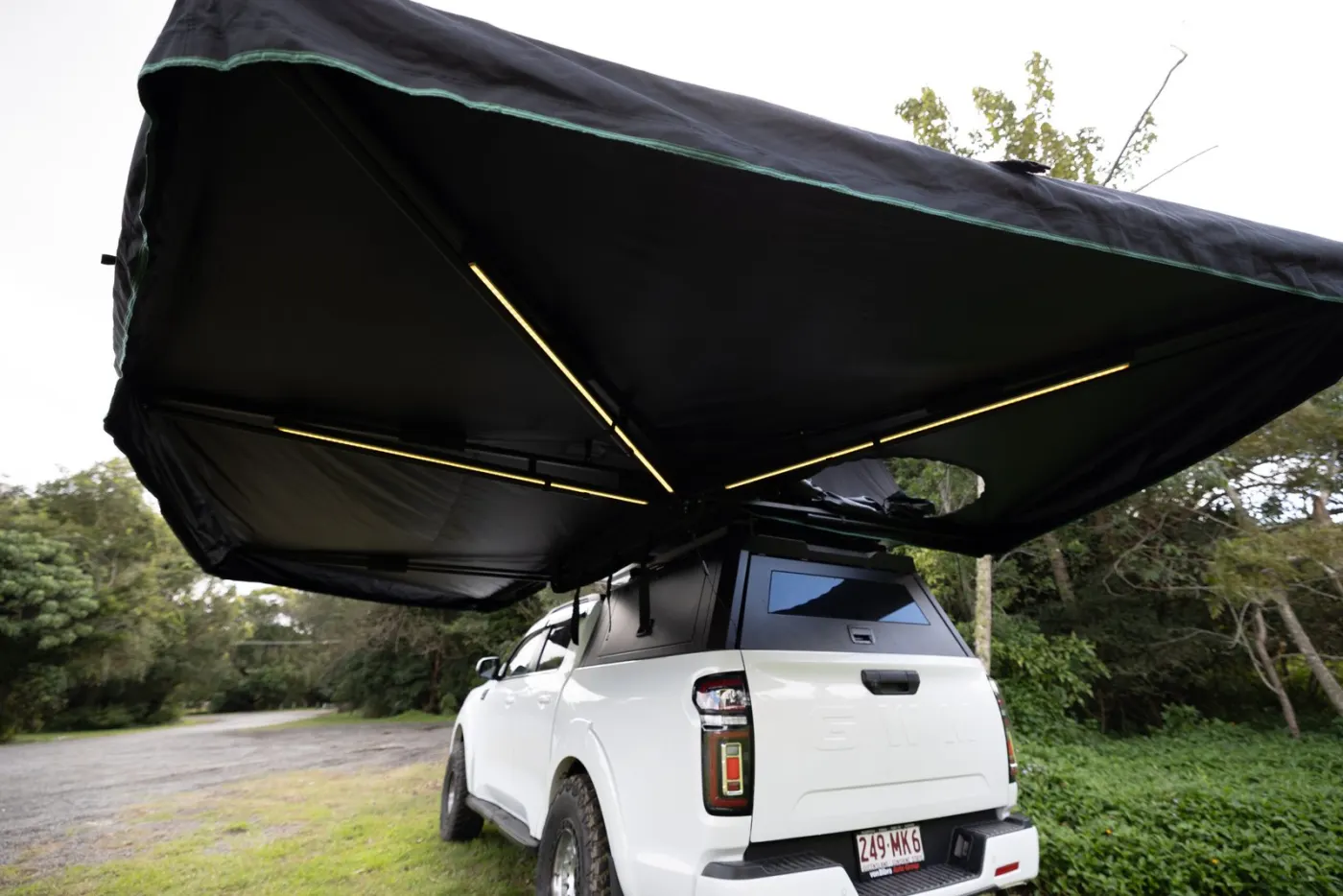
A 270 awning bracket is the metal mount that holds a 270° awning to your roof rack, platform or canopy, and the right one depends on what your rack is made of and how much the awning weighs. Many 270s mount with two or three brackets along the side of the rack, with the hinge end at the rear corner so the awning wraps around the back of the vehicle.
A 270 awning is heavier than a straight side awning and it swings out a long way from one corner, so the brackets take a lot of twisting force. This guide covers the main bracket types, how to mount one to a rack or platform, the bolt checks that matter, and which side to put it on.
What Does a 270 Awning Bracket Do?
It joins the awning's mounting rail to your rack and holds it out at the right height and angle. The bracket has to take the awning's weight while you drive, and the twisting load when the awning is open and the wind gets under it.
A good bracket setup does four things:
- Holds the awning level along the side of the vehicle
- Sets it high enough that the arms clear the doors, mirrors and canopy when it opens
- Puts the hinge corner at the rear, so the awning can swing around the back
- Stays tight on corrugations, so the awning does not shift or rattle
Brackets are matched to the rack, not just the awning. A bracket made for one platform's side rail often will not fit a round tube rack or a set of crossbars, even if it suits your awning.
What Types of 270 Awning Brackets Are There?
There are five common types, and which one you need comes down to your rack. Here is how they compare.
| Bracket type | How it fits | Suits | Watch out for |
|---|---|---|---|
| Flat or angled plate (L bracket) | Bolts to the side rail or a crossbar with channel nuts, awning bolts to the face | Platform racks with a side slot, most crossbar systems | Check the hole spacing matches your awning rail |
| Tubular rack bracket | Clamps around a round tube with U bolts or saddle clamps | Steel tube trays and cage racks | Clamps can rotate on the tube if not tightened evenly |
| Crossbar bracket | Bolts into the T slot or clamps to the end of each bar | Heavy duty bars and square bar racks | Each bar must be rated for its share of the awning's weight |
| Freestanding or tall bracket | A taller, heavier plate that braces the hinge end | Freestanding awnings, and racks that sit low | Usually heavier, and still needs legs and guy ropes in wind |
| Quick release mount | Mounts stay on the rack, awning lifts off after undoing latches | People who take the awning off between trips | Usually made for one rack system, with its own weight limit |
Rack makers sell kits matched to their own racks and to popular rivals. Rhino-Rack's awning brackets range, for example, has separate kits for its own platforms and heavy duty bars, for ARB and TJM tube trays, and for square bar Thule and Yakima racks, plus freestanding awning brackets. That is a good picture of how specific bracket fitment gets.
How Much Weight Can a 270 Awning Bracket Hold?
It depends on the bracket, and the maker should state it. Always check that the bracket's rating is above the awning's weight, and that the rack is rated for the awning on top of everything else it carries.
As an example, Dometic lists its Front Runner Slimline 3 quick release 270 awning mount with a 30 kg weight limit (checked 20 Oct 2026). Other brackets are rated higher or lower.
For reference, the RIGDUP 270° Awning 2.5M weighs 27 kg and the RIGDUP 270° Awning 2M weighs 22 kg. Whatever awning you have, add its weight to your tent, rack and other roof gear and compare the total with your rack and vehicle ratings. Our guide to roof rack weight limits shows how to add it up.
How Do You Mount a 270 Awning Bracket to a Rack or Platform?
Fit the brackets loosely, hang the awning, line it up, then tighten everything evenly. It is a two person job, because a 270 is long and awkward to hold in place.
- Read both sets of instructions. The awning maker's and the bracket or rack maker's. They tell you the bracket spacing, bolt sizes and torque.
- Pick the side and the hinge end. The hinge (the end the arms swing from) goes at the rear corner of the vehicle.
- Fit the brackets loosely to the rack. Space them to line up with the awning's mounting rail, usually one near each end and one near the middle. The hinge end carries the most load when the awning is open, so make sure a bracket sits close to it.
- Lift the awning onto the brackets. One person each end. Fit the bolts by hand.
- Set the position. Slide the awning so the hinge corner sits at or just past the rear of the rack. Set the height so the arms clear the rear door, canopy or tailgate when it opens.
- Level it. Check it sits level along its length. A sloped awning can make the arms bind.
- Tighten evenly. Snug every bolt, then torque them to the maker's figure in a few passes. Do not fully tighten one bracket before the others.
- Open it fully. Swing the awning all the way out and back. Check nothing rubs on the rack, the roof, a tent or a light bar.
On a canopy, the steps are the same, but the brackets bolt to the canopy's roof rails or its own mounting channel. Check the canopy maker allows an awning on that rail.
What Bolt Checks Should You Do on a 270 Awning?
Check every bracket bolt after the first drive, then before each trip and after any long run of corrugations. Vibration loosens bolts faster than most people expect, and a 270 swinging out from a loose bracket can damage the awning, the rack or the vehicle.
- Torque, not feel. Use a torque wrench and the maker's figure. Over tightening can crush tube racks or strip channel nuts.
- Use the right hardware. Stainless or zinc plated bolts of the size the maker lists. Do not swap in random bolts from the shed.
- Look for movement. Paint marks or witness lines across each nut make it easy to spot one that has turned.
- Check the channel nuts. On platform racks, make sure each one is seated square in the slot and has not slid along.
- Check for cracks. Look at the bracket around the bolt holes and bends, mostly at the hinge end.
- Check after a windy night. If the awning took a gust, check the hinge end bracket before you drive.
Which Side Should a 270 Awning Go On?
In Australia, many people mount a 270 on the left (passenger) side. We drive on the left, so when you pull over the passenger side faces the verge, away from traffic, and the hinge at the rear lets it wrap around behind the vehicle.
The driver side can make sense if your campsite layout or your kitchen setup suits it, or if your rear door opens the other way. But you need an awning built for that side. Many 270s are made as left hand or right hand models, because the arms swing one way from the hinge, so check with the maker before assuming one can be swapped.
| Side | Why people pick it | Check |
|---|---|---|
| Left (passenger) | Faces away from traffic when parked roadside, a common choice in Australia | Awning is a left hand model. Arms clear any rear door or canopy hatch |
| Right (driver) | Suits some camp kitchens and rear door layouts | Awning is a right hand model, and the maker sells one |
The RIGDUP 270° Awning mounts on the left (passenger) side only. If you need a driver side 270, it is the wrong pick for you.
Do You Need Special Brackets for a Freestanding 270 Awning?
Often, yes. A freestanding 270 holds itself up from the hinge end without legs in calm weather, so all of that twisting force goes through the brackets and rack. That is why many rack makers sell heavier or taller brackets made for freestanding awnings.
The RIGDUP 270° Awning is freestanding. Whatever brackets you use, drop the legs and run the guy ropes once there is any wind. That takes load off the brackets and the rack. Dometic, for one, says to secure a 270 with guy ropes in case of gusts.
What Brackets Come With the RIGDUP 270° Awning?
Check the product page for what is in the box and how it mounts, before you buy any extra brackets. If your rack needs a specific kit, ask your rack maker, because brackets are matched to the rack.
RIGDUP does not sell roof racks or awning walls. The awning itself has an aluminium frame, 280gsm ripstop rated PU3000mm, 3 LED lights and a 2.5 m radius, and it is up in about 2 minutes. For a wider look at 270s and how they compare, see our 270 awning guide.
Ready to Mount a 270 on Your Rig?
Match the bracket to your rack, check its rating is above your awning's weight, put the hinge at the rear, tighten evenly to the maker's torque, and check the bolts after the first drive. If a left side, freestanding 270 suits your setup, see the RIGDUP 270° Awning 2.5M.
FAQs
How many brackets does a 270 awning need?
It varies by awning. Two or three spaced along the mounting rail is common, with one close to the hinge end. Follow your awning maker's instructions for the number and spacing.
Can I mount a 270 awning without a roof rack?
Some people mount to a canopy's roof rails or a tub rack instead. The bare roof of a vehicle is not built for it. Whatever you mount to must be rated for the awning's weight and the twisting force when it is open.
Will any 270 awning bracket fit my rack?
No. Brackets are made for a rack type, such as a platform side rail, a round tube or a crossbar. Check that the bracket suits both your rack and your awning's hole spacing.
Can I switch a 270 awning from one side to the other?
Usually not. Many 270s are built as left hand or right hand models, because the arms swing one way from the hinge. Check with the maker, and buy the one for the side you want.
How tight should 270 awning bracket bolts be?
Tighten them to the torque figure in your awning or rack maker's instructions, using a torque wrench. Then check them again after the first drive.