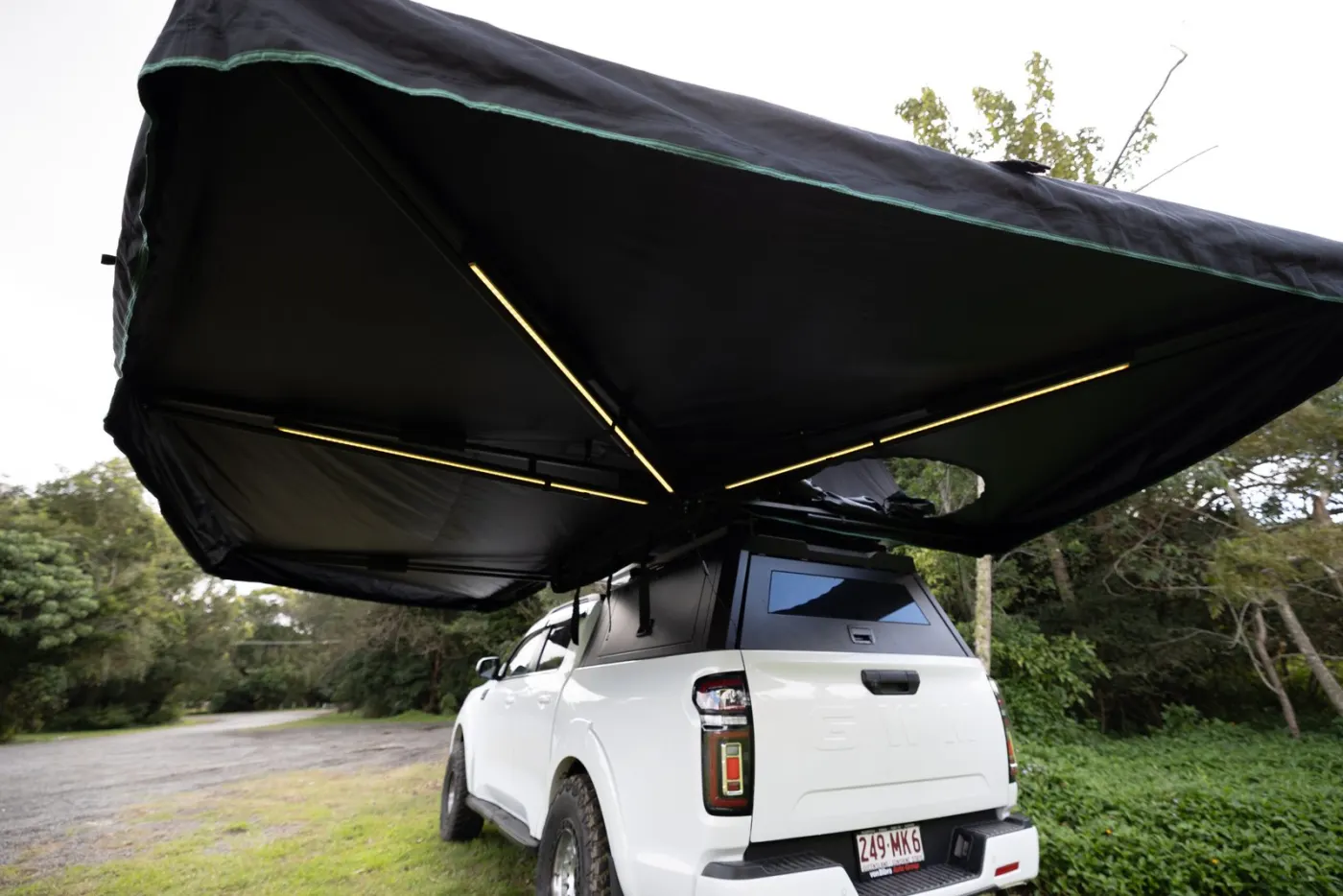
Yes, you can put a rooftop tent on a trailer, and for a lot of people it works better than the car roof. The tent needs a rack rated for its weight, the trailer needs enough payload under its ATM to carry the tent and rack, and the rack has to sit at a height that clears the lid and suits the ladder.
Get those three right and you can leave camp set up while you take the 4WD out for the day. This guide covers rack height, trailer ATM and payload, ball weight, what to check before you buy, and how a trailer setup compares with a tent on the vehicle.
Can You Put a Rooftop Tent on a Trailer?
Yes, as long as the trailer and its rack are built to carry the load. Box trailers, off road camper trailers and purpose built tent trailers all carry roof top tents in Australia. The tent bolts to cross bars or a platform on a rack over the trailer, the same way it bolts to a roof rack on a 4WD.
What changes is which limits you have to meet. On a vehicle, the roof load rating sets the ceiling. On a trailer, the vehicle roof stops being the problem. The limits that matter become:
- The rack's rating, from the rack or trailer maker
- The trailer's ATM and payload, from its compliance plate
- Your tow vehicle's towing and ball weight limits, from its owner's manual
A hardshell like the RIGDUP Nomad 1.4M weighs 72 kg, so the rack and trailer need room for that plus the rack itself, plus everything else you carry.
How High Should a Trailer Rack Be for a Rooftop Tent?
High enough to clear everything under it, and low enough that the ladder sits at a safe angle. There is no single right number. Measure your own trailer.
Work it out from the bottom up:
- Lid or tub clearance. If the trailer has a lid, a tool box or a kitchen that slides out, the rack must sit above it with room to open it while the tent is mounted.
- Gear between the tub and the tent. Some people leave a gap for jerry cans, a spare or recovery gear. Count that weight too.
- Ladder reach. The Nomad 1.4M comes with a 2.6 m ladder. Measure from the ground to the base of the tent once it is on the rack, and check the ladder reaches at a comfortable, stable angle.
- Height when towing. The closed Nomad 1.4M is 18 cm tall. Add that to your rack height to know your total height for low branches, carports and garage doors.
A trailer rack often puts the tent lower than it would sit on a 4WD roof. That makes it easier to climb in and to close the tent at the end of a trip. It also keeps the weight lower on the trailer, which helps it track behind you.
How Much Weight Can Your Trailer Carry?
Your trailer can carry its ATM minus its tare, and the tent, rack and everything else has to fit in that gap. Both numbers are on the trailer's compliance plate.
| Term | What it means | Where to find it |
|---|---|---|
| Tare | What the empty trailer weighs | Compliance plate or the maker's specs |
| ATM (Aggregate Trailer Mass) | The most the loaded trailer can weigh, including what sits on the tow ball | Compliance plate |
| Payload | ATM minus tare: everything you can add | Work it out from the two numbers above |
| Ball weight | The weight pressing down on the tow ball | Weigh it, and check your tow vehicle's limit |
Now add up what goes on the trailer:
- The rack, from the rack maker's specs
- The tent: 72 kg for the Nomad 1.4M
- Bedding, which stays in a hardshell when it closes
- Water, fuel, the fridge, food and everything else in the tub
If the total goes past your payload, something has to come off. A trailer's payload often runs out faster than people expect once the rack, water and a fridge are on board. Weigh the loaded trailer at a public weighbridge before a big trip so you are working from real numbers.
Does a Rooftop Tent Change Your Trailer's Ball Weight?
Yes. Where the tent sits front to back changes how much weight presses on the tow ball. Mount it forward of the axle and the ball weight goes up. Mount it behind the axle and the ball weight drops.
Both can cause trouble. Too little ball weight can make a trailer sway. Too much loads up the rear of your tow vehicle and takes weight off the front wheels, which lightens the steering. Your trailer maker and your tow vehicle maker both give limits, so check them.
Here is how to stay on top of it:
- Find the ball weight limit for your tow vehicle and tow bar in the owner's manual or on the tow bar
- Mount the tent so its weight sits close to the axle, not hanging off the back
- Weigh the ball weight with ball weight scales or at a weighbridge once the tent is on
- Weigh it again after you change how the trailer is loaded
A 72 kg tent sitting high on the trailer also raises its centre of gravity. Keep heavy gear low in the tub to balance it out.
What Should You Check Before Putting a Rooftop Tent on a Trailer?
Check the rack, the trailer's payload, the ball weight, the size fit and the rules in your state. Work through this list before you buy anything.
- Rack rating. Ask the rack or trailer maker for its dynamic rating (towing) and static rating (at camp, with people inside). Tent plus anything else on the rack must stay under the dynamic number. Tent, bedding and the people sleeping in it must stay under the static number. Our guide to roof rack weight limits for roof top tents shows how to do the sum.
- Mounting points. The rack should bolt to the trailer's chassis or a frame built for loads, not a thin lid or a sheet metal side.
- Payload. Rack, tent, gear and water all have to fit between tare and ATM.
- Size. The Nomad 1.4M is 217 x 150 cm closed. Check your rack's bar spacing and that the tent does not stick out past the sides of the trailer more than your state allows.
- Which way it opens. A clamshell like the Nomad opens up at one end on gas struts. Decide which end you want the ladder and entry on before you drill or bolt anything.
- Tow vehicle limits. Towing capacity, ball weight and GVM are all in your owner's manual.
- Your state's rules. Lights, safety chains, brakes, registration and load limits are set by your state transport authority.
Not sure how a hardshell bolts down? Our guide on how to install a roof top tent walks through it. The same steps apply on a trailer rack.
What Are the Towing Rules for a Trailer With a Rooftop Tent?
Towing rules are set by each state and territory, so check with your state transport authority before you tow. We are not giving legal advice here. Rules on trailer brakes, safety chains, lights, registration, inspections and load size differ from state to state.
Two places to start:
- Queensland's towing vehicles and trailers page covers equipment, loading and when a trailer needs a safety certificate in that state. Other states have their own pages on their transport authority's site.
- The federal Vehicle Standards Bulletin 1 explains the design rules for trailers with an ATM of 4.5 tonnes or less. It matters most if you are building or changing a trailer.
If you are adding a rack to a trailer or building a tent trailer from scratch, talk to your state authority before you start. Changes to a registered trailer may need to be checked.
Is a Rooftop Tent Better on a Trailer or on Your Vehicle?
A trailer suits you if you set up a base camp and explore from it, or if your vehicle's roof load is too low for a hardshell. The vehicle suits you if you move camp most days or drive tracks where a trailer is a burden.
| Tent on a trailer | Tent on the vehicle | |
|---|---|---|
| Weight limit that matters | Rack rating and trailer payload | Vehicle roof load and rack rating |
| Leave camp set up | Yes, unhitch and drive off | No, close the tent to drive |
| Vehicle roof | Free for an awning or gear | Mostly taken by the tent |
| Vehicle centre of gravity | Unchanged | Higher with the tent on top |
| Tight or technical tracks | Harder, and some tracks are not suited to trailers | Easier, nothing behind you |
| Beach and soft sand | More work, more chance of getting stuck | Simpler |
| Parking and reversing | Harder | Normal |
| Running costs | Trailer registration, tyres and bearings | None extra |
| Height to climb | Often lower | Often higher |
Pros of a Trailer Tent
- Your vehicle's roof load rating stops being the limit
- Leave the tent up at camp and take the 4WD exploring
- The vehicle roof is free for a 270° awning, a basket or a solar panel
- The vehicle handles the way it did before the tent
- The tent is usually lower, so it is easier to get in and out
- Swap tow vehicles without moving the tent
Cons of a Trailer Tent
- You tow everywhere, which uses more fuel and needs more care
- Some tracks and beaches are harder or not suited to a trailer
- Reversing and parking take more room and practice
- Trailer registration and upkeep cost money each year
- You have to watch payload and ball weight as well as the rack rating
If your trips are to places like K'gari with lots of soft sand, think hard about the trailer. Our K'gari roof top tent guide covers what the island asks of a vehicle.
Which Kind of Rooftop Tent Suits a Trailer?
A hardshell suits a trailer well, because it packs flat with the bedding inside and sits low when closed. That keeps wind and dust out of the tent while you tow on dirt roads.
Look at these when you choose:
- Weight. It has to fit the rack rating and your trailer's payload.
- Footprint. It should sit within the rack and not hang far past the trailer.
- Closed height. A slim shell adds less height and less drag.
- Power. Built in USB and 12V sockets mean fewer leads running from the trailer battery.
The RIGDUP Nomad 1.4M is a clamshell hardshell that sleeps 2. It weighs 72 kg, measures 217 x 150 x 18 cm closed and opens on gas struts in about 60 seconds. It has an aluminium shell and honeycomb base, 70mm memory foam, USB-C, USB-A and a 12V socket, and a 255W solar panel. Cross bars come in the box. RIGDUP does not sell roof racks, so you will need a rack from a rack maker or your trailer builder.
FAQs
Can any trailer carry a rooftop tent?
No. The trailer needs a rack rated for the tent's weight, mounted to a strong frame, and enough payload left under its ATM. A small, light box trailer may not have the payload or the frame for a 72 kg hardshell plus a rack.
Do you need a special rack for a rooftop tent on a trailer?
You need a rack with a published rating that covers the tent while towing and the tent plus people at camp. Many trailer makers and rack makers sell racks built for this. Ask for both ratings in writing.
Can you leave a rooftop tent set up on a trailer and drive away?
Yes, that is one of the main reasons people do it. Unhitch the trailer, chock the wheels, lower the jockey wheel and stabilisers, and take the 4WD out for the day.
Is a trailer rooftop tent the same as a camper trailer?
Not quite. A camper trailer usually has a tent built into the trailer itself. A trailer with a rooftop tent uses a standard roof top tent on a rack, which you can move to a vehicle later if you want.
Does a rooftop tent on a trailer need to be registered?
The tent itself does not, but the trailer does, and adding a rack may change what your state needs. Check with your state transport authority.
Can I move my rooftop tent from my car to a trailer?
Usually, yes. If the trailer rack has bars at the right spacing and a high enough rating, the tent bolts on the same way. Our fitting guide covers what to check before mounting a RIGDUP tent.
Ready to Set Up Your Trailer?
Once your trailer's rack rating, payload and ball weight all check out, pick a tent that fits under them. See the RIGDUP Nomad 1.4M roof top tent for full specs, what is in the box and the 2 year warranty.