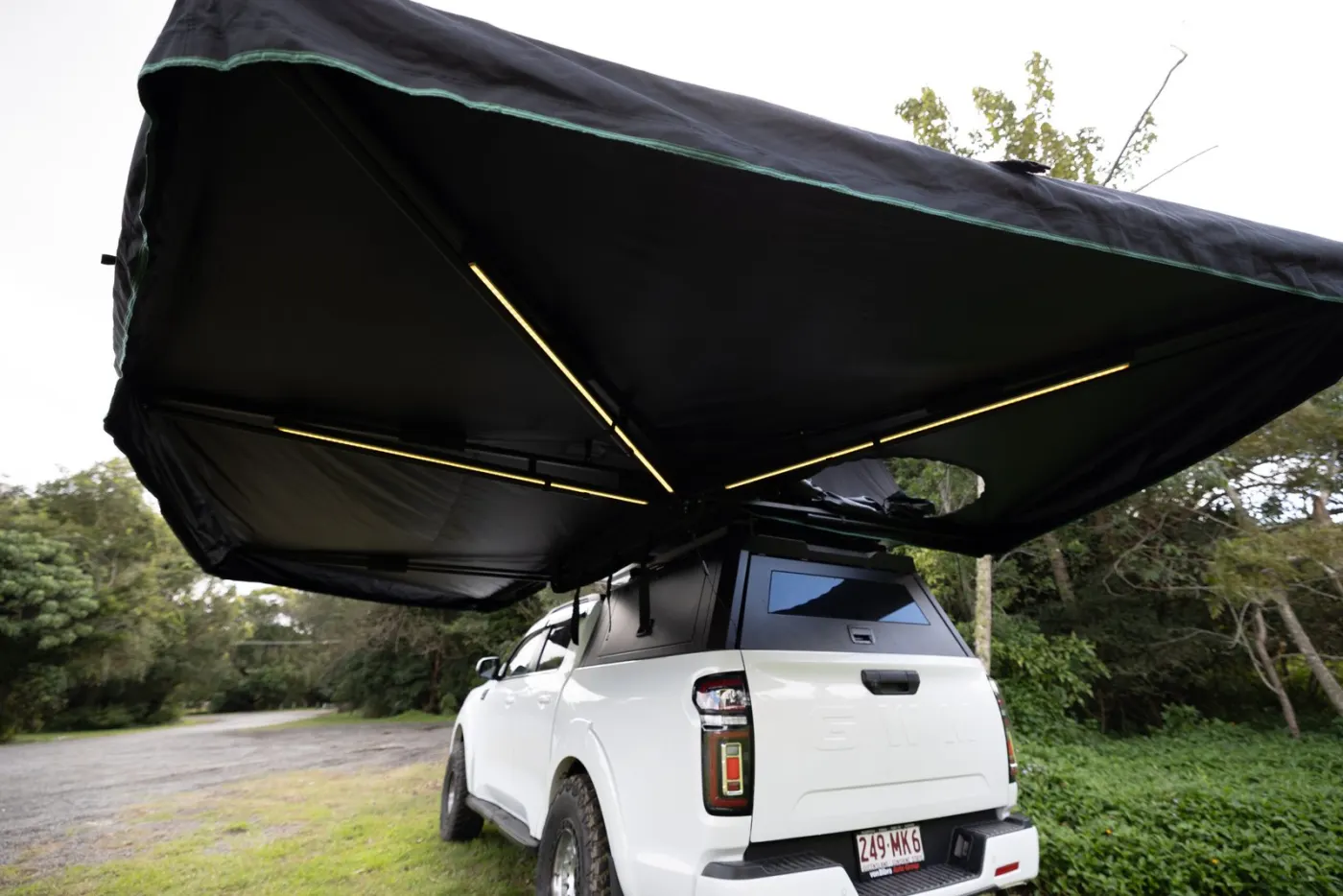
A free standing 270 awning holds itself up on its hinge and arms, with no legs, in calm weather. It is worth it if you stop often or set up camp on your own, but it does not replace legs and guy ropes: once there is wind, every freestanding awning still needs them.
This guide covers what freestanding really means, how much wind one can take, when to drop the legs, and how to pick one for your rig. If you are still deciding between a 270, a 180 and a tailgate awning, start with our car awning buying guide for Australians and come back here.
What Does Free Standing Mean on a 270 Awning?
Freestanding means the awning's hinge and arms carry the whole canopy, so it opens and stays open without legs on the ground. A standard 270 awning needs its legs down before the arms will hold their shape. A freestanding one uses a heavier hinge at the rear corner and stiffer arms, so you can swing it out, tension it and walk away in still air.
It does not mean the awning comes off the vehicle. A freestanding 270 awning still bolts to your roof rack or canopy. The word only describes how it holds itself up once open. That trips some buyers up, because "freestanding" also gets used for gazebos and shelters that stand on their own away from the car.
Here is how the two kinds compare:
| Freestanding 270 awning | Pole-supported 270 awning | |
|---|---|---|
| Stays open without legs | Yes, in calm weather | No, legs go down as you open it |
| Quick stops | Open it and go | Every leg out, every time |
| Hinge and arms | Heavier, stiffer | Lighter |
| Load on your rack brackets | Higher, the brackets carry the whole canopy | Lower, the legs share it |
| Legs and guy ropes in wind | Still needed | Needed |
Is a Free Standing 270 Awning Worth It?
For many people who camp often, yes, because it takes the fiddle out of every short stop. The real gain is not the big camp setup. It is the ten minute lunch break, the roadside cuppa and the quick shade at the beach car park, where you would never bother putting legs out on a standard awning.
It is worth it if you:
- Stop for short breaks most days on a trip
- Often set up on your own
- Camp on rocky or hard ground where legs and pegs are a fight
- Want to open the awning first and sort the legs once you know where everything goes
It is less of a win if you:
- Mostly camp at exposed coastal or desert sites where you would peg it out anyway
- Set up a base camp and stay put for a week
- Have a light roof rack that is already near its load rating, since freestanding hinges and arms often add weight
Think of freestanding as a convenience. It saves time when the air is still. It does not make the awning safer in wind than any other 270.
How Much Wind Can a Free Standing 270 Awning Take?
Not much without legs: the one published rating we found is 30 km/h. Darche rates its Eclipse 270 Freestanding LED Awning to 30 km/h in freestanding mode, and even then Darche recommends putting the support poles down and pegging the guy ropes every time (checked 20 Oct 2026).
To put 30 km/h in context, the Beaufort scale on the NSW EPA's wind chart calls 29 to 38 km/h a fresh breeze, the point where small trees in leaf start to sway. Those are average speeds. Gusts run higher, and a gust is what lifts an awning.
Not every brand publishes a freestanding wind rating, and RIGDUP does not. Where there is no number, treat any breeze you can feel as time for legs and guy ropes.
When Do You Still Need the Legs and Guy Ropes?
Use the legs and guy ropes whenever there is any wind, and any time you leave the awning alone. A sudden gust can fold the arms back over the vehicle or bend the hinge, and that is a trip-ending repair.
Put the legs down and peg the guy ropes when:
- You can feel a breeze, or the forecast mentions wind
- You walk away from camp, even for a short swim or a walk
- You go to bed with the awning still out
- It rains, so water does not pool and drag the canopy down
- You hang walls or shade screens, which catch far more wind
- You are at the beach, on a ridge or anywhere with nothing to block the wind
Pack it away when the wind is strong and steady, or when a storm is coming. Even pegged out, a 270 awning acts like a sail on the side of your rack.
How Do You Set Up a Free Standing 270 Awning Safely?
Park so the vehicle blocks the wind, then open, lock and tension the awning before you let go of it. These steps suit most freestanding 270 awnings. Your awning's own manual comes first.
- Pick the spot. Park with the awning side away from the wind. For a left side awning, that means the wind hits the driver's side. Look up for dead branches.
- Open the cover. Undo the straps or zip and let the canopy drop.
- Swing out the arms. Walk each arm out in order and lock it at the hinge.
- Tension the canopy. Pull the fabric tight so it does not flap. A loose canopy catches more wind.
- Decide on legs. Dead still and you are staying close? You can leave them up for a short stop. Otherwise, drop them now.
- Peg the guy ropes. Angle the ropes out from each leg, pegged firmly. Sand and soft ground need longer pegs or sand pegs.
- Drop one corner in rain. Set one leg lower so water runs off rather than pooling.
Pack down in reverse, and never roll a wet canopy away for long. Dry it out at the next stop or at home to stop mould.
How Do You Pick a Free Standing 270 Awning?
Start with your mounting side and your rack, then compare the rest. A freestanding awning puts its whole weight and twisting load on the mounting brackets, so the rack matters more than with a pole-supported one.
| Check | What to look for |
|---|---|
| Mounting side | Left (passenger) or right (driver) side. Pick the side you camp on, and check the model comes in it |
| Freestanding wind rating | Is one published? If not, assume legs in any breeze |
| Weight | Add it to everything else on the roof and check it against your rack and vehicle roof load |
| Rack and brackets | A strong rack with solid bracket points. A light rack can flex under a freestanding awning |
| Size | A size that suits your vehicle length, so the canopy does not hang far past the rear |
| Head height | Check the maker's listed vehicle height range against your vehicle with the rack fitted |
| In the box | Legs, guy ropes, pegs, lights and a travel cover |
| Walls | If you want walls, check the maker sells them for that exact model |
| Warranty | Length, and who handles claims |
For the weight check, our guide to roof rack weight limits walks through the maths, including a roof top tent on the same rack.
How Does the RIGDUP 270° Awning Compare?
The RIGDUP 270° Awning is freestanding, comes in two sizes and mounts on the left side only. Here it is next to a well known freestanding 270 sold in Australia.
| RIGDUP 270° Awning 2.5M | RIGDUP 270° Awning 2M | Darche Eclipse 270 Freestanding LED | |
|---|---|---|---|
| Freestanding | Yes | Yes | Yes |
| Published freestanding wind rating | None published | None published | 30 km/h |
| Size | 2.5 m radius | 2 m radius | 11.5 m² coverage |
| Weight | 27 kg | 22 kg | See Darche's page |
| Mounting side | Left (passenger) only | Left (passenger) only | Left and right versions |
| Canvas | 280gsm ripstop, PU3000mm | 280gsm ripstop, PU3000mm | 320gsm ripstop polycotton |
| Lights | 3 LED lights | 3 LED lights | Built-in LED lighting |
| Setup | About 2 minutes | About 2 minutes | See Darche's page |
| Walls from the maker | None sold | None sold | Sold separately |
| Warranty | 2 years | 2 years | See Darche's page |
| Price | On the product page | On the product page | $1,879 AUD (checked 20 Oct 2026) |
Rhino-Rack also makes a freestanding Batwing 270 in left and right hand versions, if you need a driver side awning.
Two things to be clear on with the RIGDUP. It only mounts on the left, so it is the wrong pick if you camp off the driver's side. And RIGDUP does not sell awning walls, so if a fully enclosed room is part of your plan, choose a brand that makes walls for its own awning. If you want a lighter option, the RIGDUP 270° Awning 2M is 22 kg. Both sizes are on the RIGDUP awnings page.
FAQs
Is a freestanding awning the same as a standalone awning?
No. A freestanding 270 awning still bolts to your vehicle. It just does not need legs to hold its shape in calm weather. A standalone shelter, like a gazebo, sets up away from the car.
Can I leave a freestanding 270 awning up overnight?
Only with the legs down and the guy ropes pegged. Wind often picks up overnight and you will not see it coming. If the forecast is windy, pack it away before bed.
Does a freestanding awning need a stronger roof rack?
It puts more load on the brackets, because the rack holds the whole canopy with no legs to share it. Use a solid rack, fit every bracket and check the rack's load rating before you mount one.
Is the RIGDUP 270° Awning freestanding?
Yes. It holds itself up without legs in calm weather. Use the legs and guy ropes as soon as there is any wind or you leave it unattended.
Can I fit walls to the RIGDUP 270° Awning?
RIGDUP does not sell awning walls. If walls matter to you, pick an awning whose maker sells walls for that exact model.
Does a freestanding awning work on a ute canopy?
It can, if the canopy has mounting points rated for an awning. Check the canopy maker's load rating for side mounted gear, since a freestanding awning puts more twisting load on the mounts.
Should You Get a Free Standing 270 Awning?
If you stop often and set up on your own, a freestanding 270 awning saves real time. Just keep the legs and guy ropes in the routine for anything longer than a quick, still stop.
If a left side freestanding 270 suits your rig, see the RIGDUP 270° Awning 2.5M.