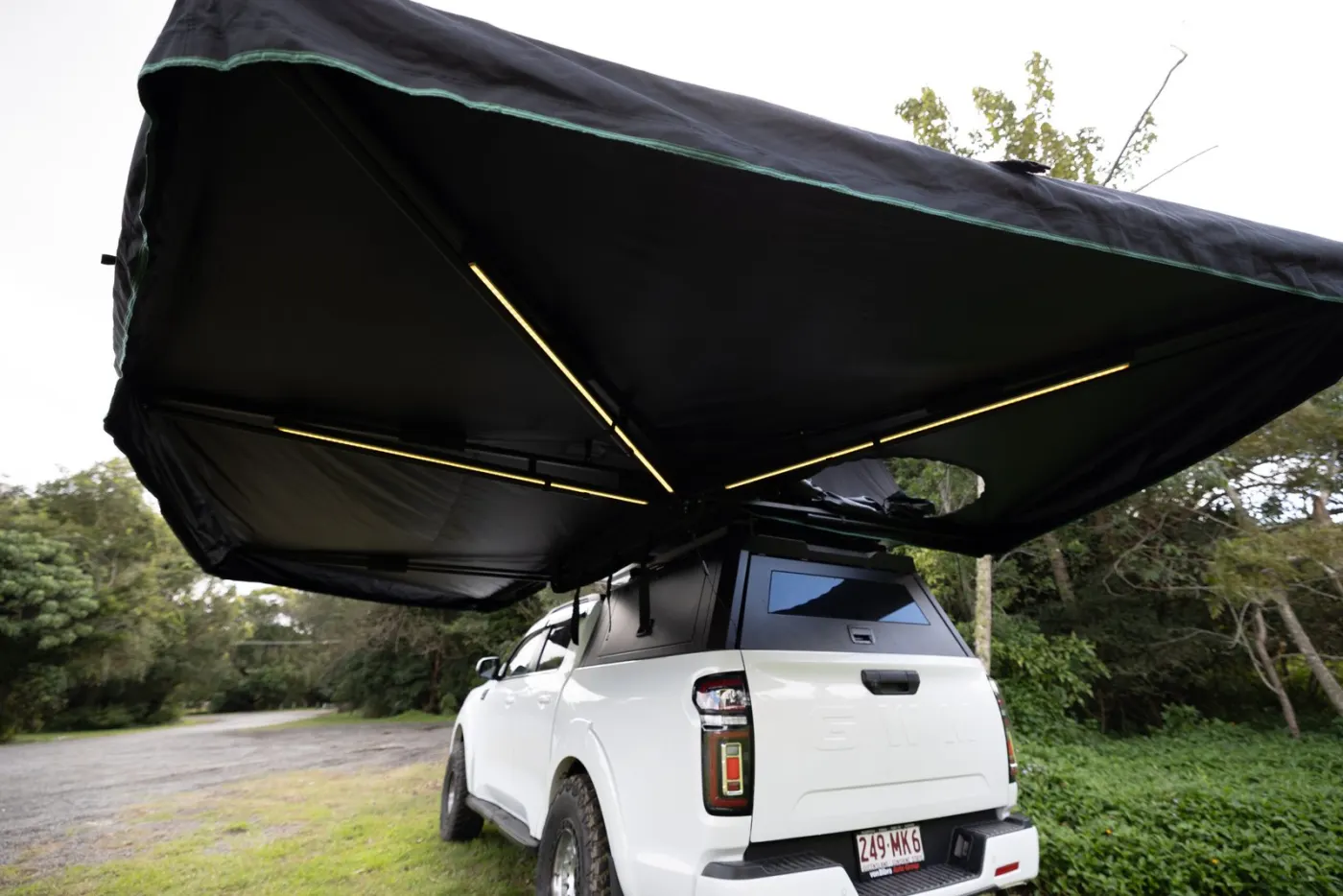
A roof top tent with a solar panel gives you free power through the day to recharge a battery, and that battery runs your lights, fan, phone charging and, in good sun, a 12V fridge. The panel alone runs nothing at night, so you also need a battery and a solar regulator (also called a charge controller) between the panel and the battery.
The short version:
- The panel makes power in daylight, most of it from late morning to mid afternoon
- The regulator turns that into a safe charge for your battery
- The battery stores it and runs your gear, day and night
- The ports (USB and 12V sockets) are where you plug in, and they need a battery behind them
Two RIGDUP tents come with a panel included. The Nomad 1.4M has a 255W solar panel, plus USB-C, USB-A and a 12V socket. The Rigdup 1.3M has a 225W solar panel and a 12V socket with an Anderson plug. Check each product page for exactly what's in the box, and plan on your own battery and regulator unless the page says otherwise.
What Can a Roof Top Tent Solar Panel Run?
A panel in the 225 to 255W range can comfortably keep up with lights, a fan and phone charging, and in good sun it can cover a small 12V fridge too. What it can run depends on how much power your gear uses in a day, compared with what the panel puts back.
Add up your daily use in watt-hours (Wh). For each item: watts x hours used = Wh. If a label shows amps, multiply by 12 to get watts at 12 V.
| Item | Figures used | Per day | Where the number comes from |
|---|---|---|---|
| 12V fan on high, 8 hours | 0.35 A x 12 V = 4.2 W, x 8 h | about 34 Wh | Caframo's stated draw for the Sirocco II fan |
| LED camp light, 4 hours | 5 W x 4 h | 20 Wh | Example only, check your light |
| Two phone charges | about 20 Wh each, with charging losses | about 40 Wh | Example only, check your phone |
| 12V fridge, 24 hours | averaging 1 A x 12 V = 12 W, x 24 h | about 290 Wh | Example only, hot weather pushes it up |
| Total | about 384 Wh |
Swap in the numbers from your own gear. Fridge makers often list an average draw at a set outside temperature, and that one item is often most of the total.
What a panel this size won't run: anything that heats or cools a lot. Kettles, hair dryers, electric blankets on high and air conditioners draw hundreds of watts or more. They'll flatten a camping battery fast, solar or not.
How Much Power Does a 255W Solar Panel Make in Real Conditions?
A rough estimate is about 0.9 to 1.3 kWh (900 to 1,300 Wh) on an average day, if the panel gets full sun with no shade. That's an estimate, not a test result, and real camp days often come in lower.
Here's where it comes from. The Australian Government's Your Home guide to rooftop solar says a 1 kW system makes around 4 kWh a day averaged across the year, and lists typical daily figures per kW for each capital city. Scale those down to the panel size and you get this:
| Place | Your Home figure per 1 kW per day | Estimate for 255W | Estimate for 225W |
|---|---|---|---|
| Alice Springs | 5.0 kWh | about 1,275 Wh | about 1,125 Wh |
| Darwin | 4.4 kWh | about 1,120 Wh | about 990 Wh |
| Brisbane | 4.2 kWh | about 1,070 Wh | about 945 Wh |
| Sydney | 4.0 kWh | about 1,020 Wh | about 900 Wh |
| Melbourne | 3.6 kWh | about 920 Wh | about 810 Wh |
| Hobart | 3.5 kWh | about 890 Wh | about 790 Wh |
These are estimates scaled from home rooftop figures, averaged across the year. Summer days give more, winter days less. A home system is fixed at a good angle with no shade. A panel at camp often isn't, so treat these as the top of the range.
To turn watt-hours into amp-hours at 12 V, divide by 12. So 1,000 Wh is roughly 83 Ah, before losses in the regulator and battery.
Want a number for a specific trip? The Bureau of Meteorology solar exposure maps show average daily sun by month, in megajoules per square metre (MJ/m²). Divide that number by 3.6 to get "sun hours", then multiply by your panel's watts. As a worked example: 18 MJ/m² divided by 3.6 is 5 sun hours, and 5 x 255 W is about 1,275 Wh at best. Take some off for heat, angle and shade.
Why Does a Solar Panel Make Less Than Its Rated Watts?
A panel's watt rating is measured in lab conditions: full, direct sun at a panel temperature of 25°C. Out at camp, it almost never sees all of that at once, so it makes less.
- Heat: Your Home says output drops by around 1% for every 3 to 4°C above 25°C. A panel at 55°C on a summer roof, as an example, is 30°C over, so roughly 8 to 10% down
- Angle: a panel lying flat gets less sun in the morning, the afternoon and through winter than one tilted toward the north
- Shade: Your Home notes that shading part of a panel can cut output across more than the shaded cells, because the cells are wired together
- Cloud: overcast days cut output hard, and a run of them is when your battery size matters
- Dust: red dust and bird droppings block light. Wipe the panel when you wipe the windscreen
- Time of day: the sun before 9am and after 4pm adds little
There's a catch for tent owners too. You want the tent in shade on a hot afternoon to stay cool, but a panel wants full sun. If your panel is on the tent or the roof, parking for shade costs you power. Plan your charging for the morning, or use a panel you can move into the sun.
What Else Do You Need With a Roof Top Tent Solar Panel?
You need a battery, a solar regulator, and the right cables and fuses to join them. Without a battery, there's nowhere to store the power for night. Without a regulator, the panel can overcharge or damage the battery.
| Part | What it does | What to check |
|---|---|---|
| Battery | Stores the power and runs your gear | Usable capacity in Ah, weight, where it lives (canopy, drawer, portable box) |
| Solar regulator | Controls the charge going into the battery | Matches your panel's watts and your battery type. MPPT types usually get more out of a panel than PWM types |
| Cables and plugs | Carry power from panel to regulator to battery | Thick enough for the run length, with Anderson plugs or similar |
| Fuses | Protect the wiring if something shorts | Fitted close to the battery, rated for the cable |
REDARC, an Australian maker, describes its solar regulators as making sure the power from a panel is regulated to the right voltage to charge an auxiliary battery. Some battery boxes and DC to DC chargers have a regulator built in, so check before you buy two.
For anything wired into the vehicle, use an auto electrician. A bad 12V job can melt cables or flatten your starting battery.
How Big a Battery Do You Need With a Tent Solar Panel?
Big enough to get through the night, plus at least one cloudy day. Using the example loads above (about 384 Wh a day), here's how that works out:
- One day of use: 384 Wh divided by 12 is about 32 Ah
- Two days with little sun: about 64 Ah
- Lithium (LiFePO4): most of the rated capacity is usable, so a battery around 70 to 100 Ah gives room to spare
- AGM or lead acid: usually only run down to about half, so you'd want roughly double the Ah
Drop the fridge and your daily use falls to under 100 Wh. A good power bank or small battery box handles that, and the panel tops it up easily.
Weight adds up fast on the roof. If a battery or extra panel goes on the rack with the tent, add it to the total and check it against your vehicle's limits. Our guide to roof rack weight limits for roof top tents shows how.
Is a Fixed Solar Panel Better Than a Portable One?
It depends on how you camp. A panel fixed to the tent or roof is always there and needs no setup. A portable panel can chase the sun while the car sits in the shade. Some people end up with both.
| Panel fixed to the tent or roof | Portable panel on the ground | |
|---|---|---|
| Setup | Nothing to unpack | Unfold, aim, run the cable |
| Sun vs shade | Goes where the vehicle goes | Sits in the sun while you park in shade |
| Angle | Usually flat or close to it | Tilt it toward the sun through the day |
| Theft risk | Lower | Higher, if left out at camp |
| Roof weight | Adds to the load on your rack | Rides inside the vehicle |
A panel that comes with a tent saves buying one. Check the product page for how the included panel mounts and connects, so you know which column it fits. If you camp in one spot for a few days in summer, a portable panel as well gives you more power without giving up shade. If you move most days, a panel that's always set up is less to think about.
Nomad 1.4M vs Rigdup 1.3M: Which Has More Solar?
The Nomad 1.4M has the bigger panel: 255W against 225W on the 1.3M. Using the Brisbane estimate above, that's about 125 Wh more on an average sunny day, roughly 10 Ah at 12 V.
| Nomad 1.4M | Rigdup 1.3M | |
|---|---|---|
| Solar panel included | 255W | 225W |
| Power outlets | USB-C, USB-A and 12V socket | 12V socket with Anderson plug |
| Shell | Clamshell hardshell | Clamshell hardshell, smaller than the 1.4M |
| Other listed features | Cross bars in the box, 70mm memory foam | Cross bars, condensation pad, 360° LED light, 70mm memory foam |
The USB-C and USB-A ports on the 1.4M mean phones and USB fans plug straight in, without an adaptor in the 12V socket. See both side by side on the RIGDUP compare page.
Check each product page for exactly what's in the box, and plan on your own battery and regulator unless it says otherwise.
FAQs
Can a roof top tent solar panel run a fridge?
In good sun, a 225 to 255W panel can usually keep up with a small 12V fridge, as long as you have a battery to run it overnight. Check your fridge maker's average draw, multiply by 24 hours, and compare it with the estimates above. Cloudy days and very hot weather are where it falls short.
Does a solar panel work on a cloudy day?
Yes, but far less. Thick cloud can cut output to a small part of a sunny day. That's why the battery should cover at least one day with little sun.
Can I charge my car's starting battery from the tent's panel?
It's safer to charge a separate second battery. Running your camp gear from the starting battery risks a flat battery in the bush. An auto electrician can set up a dual battery system that charges from both the alternator and solar.
Can I add another solar panel?
Often, yes, but your regulator has to handle the extra watts. Check the regulator's maximum input before adding a panel, or use a second regulator. A portable panel is a simple way to add more without touching the roof.
Do I need to clean the solar panel?
Wipe off dust and bird droppings when you see them. Anything covering part of the panel cuts output. Use water and a soft cloth, never anything abrasive.
Want a hardshell with a 255W solar panel, USB-C, USB-A and a 12V socket? See the RIGDUP Nomad 1.4M roof top tent.