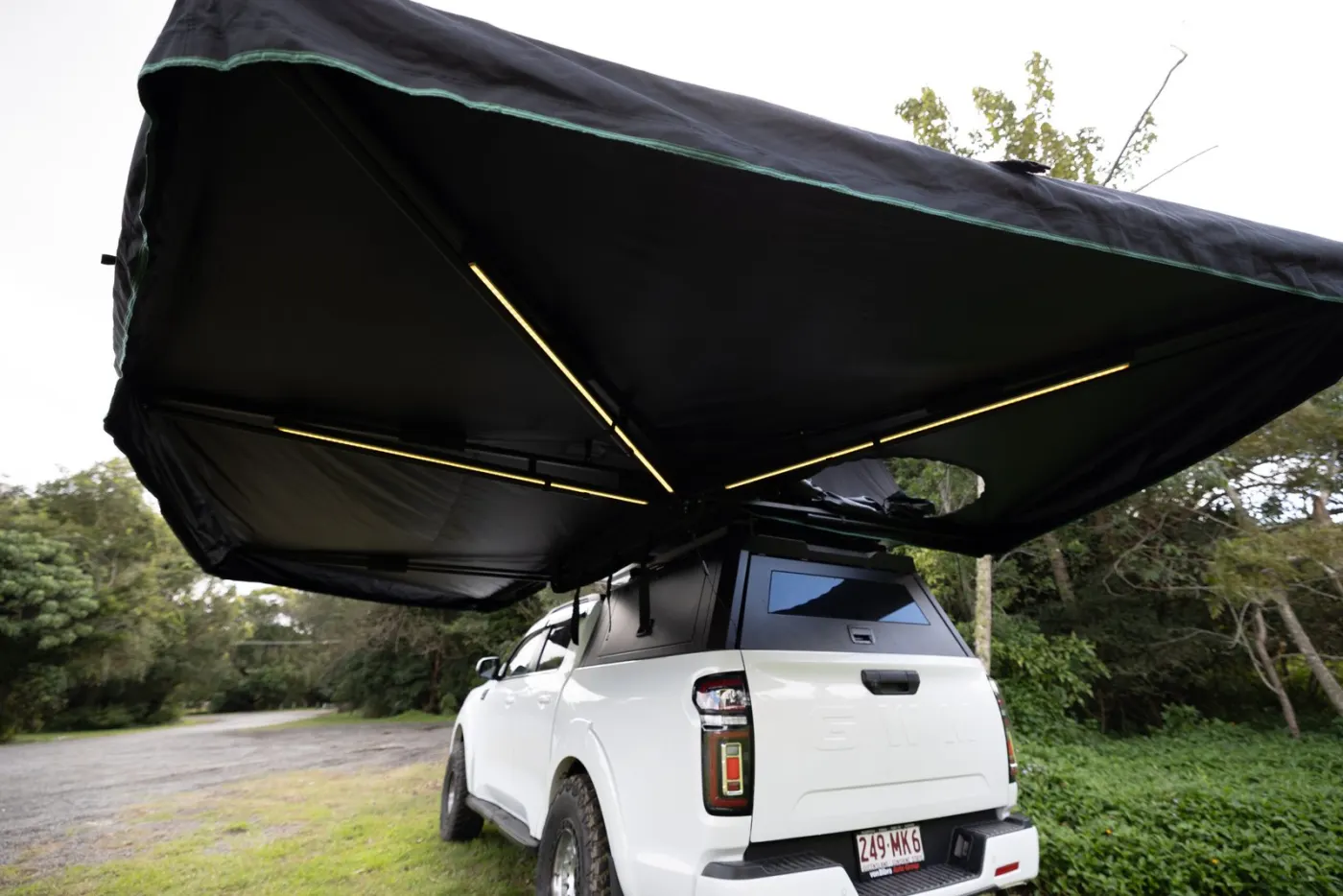
A slim roof top tent is one that sits low on the roof when it is closed, roughly 20 cm or less from the base to the top of the lid. That low closed height means less wind noise and drag, more clearance under garage doors and car park bars, and a tidier look on the vehicle, but you usually give up some storage room and headroom to get it.
There is no official cut-off for "slim", "slim line" or "thin", so the number worth trusting is the closed height on the maker's spec sheet. This guide covers what makes a tent slim, why it matters, the trade-offs, and how to measure your total height before you buy.
What Makes a Roof Top Tent Slim?
A roof top tent is slim when its closed height is low, and closed height is the one spec that tells you. It is the distance from the bottom of the tent base to the top of the shell when the tent is packed down for driving. A few things decide it:
- Shell type. Hard shells usually pack flatter than soft shell fold-outs, because the lid is a rigid panel rather than a folded tent under a cover.
- Base build. A thin, stiff base, such as aluminium honeycomb, keeps height down without flexing.
- Mattress and bedding. A thick mattress needs a deep shell. Thinner foam lets the lid close lower.
- How it opens. A clamshell hinges at one end. A pop-up lifts straight up on four struts. Both can be slim, but the hinge and strut hardware adds a little height.
- What is bolted to the outside. Rails, solar panels and lid accessories all add to the real height on the roof.
Three tents for comparison, from each maker's spec sheet:
| Tent | Type | Closed Height | Source |
|---|---|---|---|
| RIGDUP Nomad 1.4M | Clamshell hard shell | 18 cm | RIGDUP specs |
| Rhino-Rack Low Profile Roof Top Tent | Hard shell | 200 mm (20 cm) | Rhino-Rack product page (checked 20 Oct 2026) |
| iKamper Skycamp 3.0 Mini | Compact hard shell | 34 cm | iKamper product page (checked 20 Oct 2026) |
The iKamper is in the table on purpose. It is a compact tent with a small footprint, but it is not slim. Compact and slim are different things, and the next sections explain why that matters.
Why Does Closed Height Matter on a Roof Top Tent?
Closed height matters because the tent spends far more time packed on the roof than open at camp. Every kilometre you drive, every garage you enter and every car park you pull into, you carry that height with you.
Wind noise and handling
A taller box on the roof pushes more air out of the way. That means more wind noise at highway speed and more push from crosswinds, which you feel on open roads and when a truck passes. A low shell gives the wind less to grab.
Fuel use
Anything on the roof adds drag, and drag costs fuel, mostly at highway speed. A lower frontal area adds less drag than a tall one. How much you save depends on your vehicle, your rack and how fast you drive, so be wary of anyone quoting an exact figure for your rig.
Garage and car park clearance
This is the one that catches people out. A tent that adds 35 cm to your height instead of 20 cm can be the difference between fitting into a home garage or a shopping centre car park and hitting the entry bar. Height signs are posted at car park entries: read them every time until you know your number by heart.
Looks
A slim shell sits closer to the roof line, so the vehicle looks less top heavy. That is personal taste, but plenty of people use their 4WD or ute as a daily driver and want it to look tidy on the school run.
Is a Slim Roof Top Tent the Same as a Lightweight or Compact One?
No. Slim, lightweight and compact describe three different specs, and a tent can score well on one and poorly on another.
| Word | What It Measures | Why It Matters |
|---|---|---|
| Slim (slim line, thin, low profile) | Closed height | Wind, fuel, garage and car park clearance, looks |
| Lightweight | Weight in kg | Roof load rating, rack rating, handling |
| Compact | Footprint (length and width) when closed | Fits shorter roofs, leaves room for other gear |
The Nomad 1.4M shows the difference. It is slim at 18 cm closed, but at 72 kg it is not a lightweight tent, and at 217 x 150 cm it is not a small footprint either. If weight is your main worry, read our guide to the lightest roof top tents in Australia instead. Slim does nothing for your roof load rating.
When people search for a "compact roof top tent", they usually want one of these three things. Work out which one your vehicle needs before you shop.
What Do You Give Up With a Slim Roof Top Tent?
You usually give up some storage space inside the shell and some headroom at one end. A slim shell is a trade, not a free win.
- Less room for bedding. A low lid means less space for thick pillows and doonas when the tent is closed. Test that the lid shuts with your bedding inside before your first trip.
- A thinner mattress, sometimes. Some slim tents use thinner foam to keep height down. Check the mattress depth on the spec sheet. The Nomad 1.4M has 70mm memory foam inside its 18 cm shell.
- A sloped roof inside. A clamshell opens at one end, so headroom is tall at the open end and lower at the hinge end. Pop-ups give even headroom but use more hardware.
- Less sleeping area than a fold-out. Soft shell fold-outs open to a bigger floor, often with an annex underneath, but they pack taller. Our hard shell vs soft shell guide covers that trade in full.
- Lid load limits. Some slim hard shells let you carry gear on the lid, with a set limit. Rhino-Rack lists a 30 kg total load rating on its Low Profile tent's roof, including the crossbars. If you plan to carry gear up there, check the limit for your tent first.
For couples who mostly drive and camp a night or two at a time, a slim hard shell is often a good fit. For families who want a big floor, a fold-out may suit better even though it sits taller.
How Do You Measure Your Total Height With a Roof Top Tent?
Add your vehicle height, the height your rack or bars add above the roof, and the tent's closed height, then measure the real thing once it is fitted. Here is how:
- Find your vehicle's overall height. It is in the owner's manual or on the maker's spec page. Check whether it includes the factory roof rails.
- Measure what the rack adds. Stand a straight edge on the top of the rack or bars and measure from the roof skin, or use the rack maker's listed height.
- Add the tent's closed height from the tent maker's spec sheet.
- Add anything on top, such as a light bar, antenna or gear on the lid.
- Allow for suspension and tyres. A lift kit or bigger tyres raise the whole lot.
- Measure the fitted vehicle on flat ground with a tape from the highest point to the ground. This is the number that counts.
- Write it down on a sticker on your dash or sun visor so you can check it at every car park.
Example, using made-up round numbers (not a real vehicle):
| Item | Height |
|---|---|
| Vehicle overall height | 1,850 mm |
| Rack or bars above the roof | 100 mm |
| Tent closed height (18 cm shell) | 180 mm |
| Estimated total | 2,130 mm |
In that example, the same vehicle with a 34 cm tent would sit at 2,290 mm. That 16 cm can decide whether you clear a car park bar. Always trust the tape measure over the sum.
How Slim Is the RIGDUP Nomad 1.4M?
The Nomad 1.4M is 18 cm high when closed, and it is a clamshell hard shell that opens on gas struts. Here are its specs:
| Spec | Nomad 1.4M |
|---|---|
| Closed size | 217 x 150 x 18 cm |
| Open size | 217 x 150 x 150 cm |
| Inside | 210 x 145 cm, sleeps 2 |
| Weight | 72 kg |
| Shell and base | Aluminium shell, aluminium honeycomb base |
| Mattress | 70mm memory foam |
| Canvas | 320gsm ripstop poly-cotton, PU3000mm, UV50+ |
| Power and solar | USB-C, USB-A and 12V socket, 255W solar panel included |
| In the box | Cross bars, 2.6 m ladder |
| Setup | Up in about 60 seconds |
| Warranty | 2 years |
Being slim does not make it light. At 72 kg, the tent and your rack together need to fit under your vehicle's dynamic roof load rating and your rack's rating, whichever is lower. Run your numbers through the RIGDUP fitting guide before you buy.
What Should You Check Before Buying a Slim Roof Top Tent?
Check the closed height on the spec sheet, then check that the tent still suits your roof, your bedding and how you camp. A quick list:
- Closed height from the maker, and whether it includes rails, struts or a solar panel
- Your fitted total height against your garage and the car parks you use
- Weight against the lower of your vehicle's and rack's dynamic roof load ratings
- Mattress depth and whether your bedding fits with the lid shut
- Headroom at both ends if it is a clamshell
- Footprint against your roof length and rack spread
- Lid load limit if you want to carry gear on top
- Warranty and local support
FAQs
What is a slim line roof top tent?
It is the same thing as a slim or low profile roof top tent: one with a low closed height, usually a hard shell. Brands use the words differently, so compare the closed height in mm or cm, not the name.
Is a thin roof top tent quieter to drive with?
Usually, yes. A lower shell catches less wind, so there is less noise and less push from crosswinds. Your rack, bars and how the tent is mounted also affect noise.
Will a slim roof top tent fit in my garage?
Maybe. Measure your garage door opening, then measure your fitted vehicle from the highest point to the ground. Allow a gap for the door mechanism and for the vehicle rising over a lip or slope.
Does a slim roof top tent use less fuel?
It adds less drag than a taller tent, so it should cost less fuel at highway speed. The exact difference depends on your vehicle, rack and speed. Any roof load adds some drag.
Is a slim roof top tent lighter?
Not always. Slim is about height, not weight. The Nomad 1.4M is 18 cm closed and weighs 72 kg, which is not light. Check the weight against your roof load rating separately.
Is the Nomad 1.4M Right for Your Vehicle?
If you want a low closed height and your roof and rack can carry 72 kg plus the rack, the Nomad 1.4M is worth a look. It is 18 cm closed, sleeps 2, and comes with a 255W solar panel and cross bars in the box. See the Nomad 1.4M roof top tent for full details.