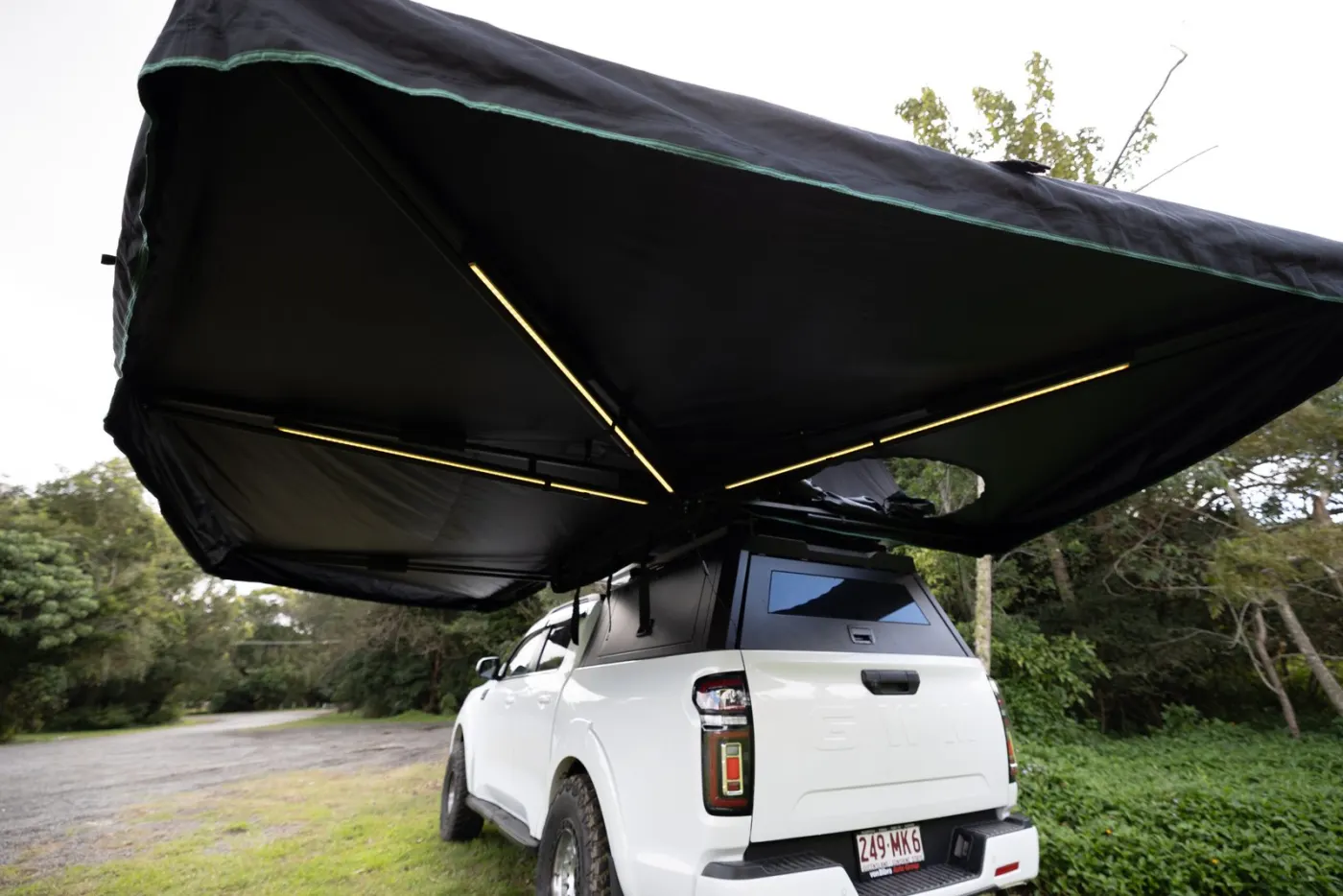
A side opening roof top tent hinges along one long edge, so the lid tilts up over the side of your vehicle and you climb in from the side. A clamshell hinges at one end, so the lid rises in a wedge from your feet to your head, and a fold-out flips open over the side to give you about double the floor.
Pick a side opening tent if you want even head room along the full length and a door that faces camp. Pick a clamshell if you want the simplest, quickest tent that sits nose into the wind. Pick a fold-out if floor space matters more than pack-down speed. This guide covers how each one opens, the space inside, wind, where the ladder goes and who each style suits. If you are still deciding between hard and soft tents in general, read our hardshell vs softshell roof top tent guide first. This post is about the opening style.
What Is a Side Opening Roof Top Tent?
A side opening roof top tent is a hardshell tent whose lid is hinged along one long edge instead of one end. Gas struts push the free edge up, so the tall side of the tent faces out over the side of the vehicle. The canvas walls form a wedge, low along the hinge and high along the open side.
You get in through a big door on the high side, using a ladder that leans against the side of the vehicle. Inside, you can sit up along most of the length of the tent on the high side, which is the main reason people choose one.
Most side opening tents are aluminium or fibreglass shells with the same basic parts as any hardshell: latches, gas struts, a foam mattress that stays inside, and a telescopic ladder. Closed, they look much like a clamshell. The difference only shows once the lid goes up.
How Does a Clamshell Roof Top Tent Open?
A clamshell roof top tent hinges at one end, and gas struts lift the other end so the lid opens like a clamshell. The roof slopes from the hinge end down low to the open end up high, so you get the most head room where your head goes and less at your feet.
You undo the latches, the struts do the lifting, and the tent is up. The door usually sits at the high end, and many clamshells add side windows or a side door too. Packing down is the reverse: pull the lid down by its strap and close the latches. Bedding stays inside.
The RIGDUP Nomad 1.4M works this way. Its aluminium roof hinges up at one end on gas struts, and it is up in about 60 seconds.
How Is a Fold-Out Tent Different From Both?
A fold-out tent is a different animal: it is a canvas tent on a hinged base that flips open over the side of the vehicle, so the floor ends up about twice the size of the folded tent. Half the floor sits on the roof rack and half hangs out past the side, held up by the ladder.
Some fold-outs have a hard cover over the folded tent for travel, but they are not hardshells. Once open, the roof is canvas on a pole frame. You get a lot more floor, room for 2 to 3 in many models, and often space for an annex underneath the overhang. In return, set up and pack down take longer, because you remove a cover, unfold the body, set the ladder and often fit window poles.
Side Opening vs Clamshell vs Fold-Out: How Do They Compare?
Here is how the three styles stack up on the things that matter at camp. These are general traits of each style. Individual models vary, so check the maker's numbers for any tent you are looking at.
| Feature | Side opening hardshell | Clamshell hardshell | Fold-out |
|---|---|---|---|
| Hinge | Along one long edge | At one end | Along the side of the base, the tent flips over |
| Open shape | Wedge, tall along the open side | Wedge, tall at one end | Box shape on a pole frame |
| Head room | High along the full length of one side | High at the head end, low at the feet | Even across most of the tent |
| Floor area | Same as the shell | Same as the shell | About double the folded base |
| Door and ladder | Side of the vehicle | Usually the high end, sometimes the side | Side of the vehicle, ladder holds the floor up |
| Set up | About a minute, struts do the work | About a minute, struts do the work | Several minutes, more steps |
| Bedding stays inside | Yes | Yes | Usually, if it is not too thick |
| In wind | Big flat face side-on, park with the hinge side to the wind | Small face, park the low end into the wind | Most canvas, needs guy ropes |
| Annex room underneath | Little | Little | Yes, under the overhang |
| Suits | Couples who sit up and read, side-on views | People who move camp most days | Longer stays, more sleeping room |
There is also a fourth hardshell style, the pop up, where the whole roof rises on all four corners for even head room. It is less common than the other two.
Which Style Gives You the Most Room Inside?
A fold-out gives you the most floor, and a side opening hardshell gives you the most usable head room for its size. A clamshell has the same floor as a side opener of the same shell size, but the sloping roof means you can only sit up at one end.
That matters more than it sounds. On a wet afternoon, two people in a clamshell sit side by side at the high end with their legs down the low end. In a side opener, you can both sit up with your backs to the high wall and your legs across the tent. Lying down, there is no difference: both hardshell styles sleep on the same footprint, set by the shell.
So if you mostly use the tent to sleep, a clamshell gives up very little. If you spend time inside it awake, reading, changing or waiting out rain, the side opener's extra head room is worth a look. If you want room for 2 to 3 people, neither hardshell style will do it in a typical width, and a fold-out or a bigger tent is the honest answer.
Which Opening Style Handles Wind Better?
A clamshell parked with its low hinge end into the wind usually handles wind best, because the wind meets the small, sloped end of the wedge. A side opener presents a large flat face side-on, so it pays to park with the hinge side to the wind. A fold-out has the most canvas and depends on guy ropes.
The rule for all three is the same: point the low, closed part of the tent at the wind. That is easy when you can choose how you park. It is harder on a narrow beach track or a tight caravan park site, where your vehicle has to sit a certain way. Think about where you camp most. If you often camp on exposed coast, a tent you can turn nose or tail into the wind is easier to live with.
Check the forecast before you set up, not just the average wind. The Bureau of Meteorology notes that wind forecasts are averages and gusts can be 40 per cent stronger, and stronger again in storms. If gusts are heading past what your tent maker says it can take, pack it down and sleep in the car.
Where Does the Ladder Go on Each Style?
On a side opening tent the ladder goes on the side of the vehicle, under the door. On a clamshell it usually goes at the high end, which faces the rear or front depending on how the tent sits on the rack, though some clamshells have a side door too. On a fold-out, the ladder goes on the side and also holds up the overhanging half of the floor.
In Australia we drive on the left, so the kerb side is the left (passenger) side. If you camp beside a road or in a caravan park, a door and ladder on the kerb side keeps you out of traffic. Some side opening tents are made for overseas markets where the kerb is on the right, so check which side yours opens on before you buy, and whether it can be mounted to open on the other side.
Also check the ladder length against your vehicle. Measure from the ground to the top of your roof rack, then compare it with the ladder's reach. Our fitting guide walks through it. The Nomad 1.4M comes with a 2.6 m ladder.
Can You Run an Awning With a Side Opening Tent?
Yes, but plan the layout first, because the tent door and the awning often want the same side of the vehicle. Many 270° awnings mount on the left (passenger) side, including ours. A side opening tent that also opens on the left puts the ladder right where the awning arms swing.
That can work well, since you step off the ladder straight into shade. It can also mean the ladder blocks an awning leg, or the awning has to go up before you can reach the door. Lay out both on paper with the measurements from each maker, or set them up at home before your first trip. A clamshell with its door at the rear avoids the clash entirely.
Is a Side Opening Tent Heavier?
Not by design. Weight depends on the shell material, size and fittings far more than on which edge the hinge is on. A side opener and a clamshell of the same size and material weigh about the same. Fold-outs with a hard cover can be heavier than either, because of the larger floor, frame and canvas.
Whatever you pick, the tent's weight has to fit inside your vehicle's dynamic roof load and your roof rack's rating while driving. Those numbers are in your vehicle owner's manual and your rack maker's instructions. Our guide to roof rack weight limits for roof top tents shows how to check both. For reference, the Nomad 1.4M weighs 72 kg.
Which Style Suits Which Kind of Camper?
A clamshell suits people who move camp most days, a side opener suits couples who spend time inside the tent awake, and a fold-out suits people who stay put and want room. Here is a quick way to pick.
- You drive most days and set up late: clamshell. Latches off, lid up, bed made. Pack down is just as quick in the morning.
- You often camp on exposed coast or open plains: clamshell, parked nose or tail into the wind.
- You like to sit up, read or work in the tent: side opener, for head room along the full length.
- You want views out the side, like a beach or a river: side opener, with the big door facing the view.
- You stay three or more nights in one spot: fold-out, so the extra set up time is spread over more nights.
- You need room for 2 to 3: fold-out, or a larger tent of any style.
Where Does the RIGDUP Nomad 1.4M Fit In?
The Nomad 1.4M is a clamshell hardshell. Its roof hinges up at one end on gas struts and it is up in about 60 seconds, so it suits people who move camp often and want a quick, simple tent.
- Sleeps 2, with an inside space of 210 x 145 cm
- Open: 217 x 150 x 150 cm. Closed: 217 x 150 x 18 cm
- 72 kg, with an aluminium shell and aluminium honeycomb base
- 320gsm ripstop poly-cotton canvas, PU3000mm, UV50+
- 70mm memory foam mattress
- 2.6 m ladder, cross bars in the box
- USB-C, USB-A and 12V socket, plus a 255W solar panel included
- 2 year warranty
It is not a side opener and not a fold-out, so if you want even head room along the full length, or room for more than 2, look at those styles instead. You can see all our tents on the roof top tents page.
FAQs
Is a side opening roof top tent bigger than a clamshell?
Not on the floor. Both sleep on the shell's footprint. The side opener has more head room along its length, so it feels bigger when you sit up.
Which side should a roof top tent open on in Australia?
Usually the left (passenger) side, which is the kerb side when you pull over. Check which side a tent opens on before you buy, as some are made for overseas markets.
Do side opening tents set up slower than clamshells?
No. Both use gas struts, so both are up in about a minute on most models. Fold-outs take longer.
Is the Nomad 1.4M a side opening tent?
No. It is a clamshell. The roof hinges up at one end on gas struts.
Can I fit an annex to a hardshell tent?
It depends on the model and the maker's own accessories. RIGDUP does not sell annexes. Fold-outs are easier, because the overhang gives the annex something to hang from.
Is the Nomad 1.4M the Right Clamshell for You?
It is if you want a quick clamshell for two that suits moving camp most days. See the full specs, photos and what comes in the box on the RIGDUP Nomad 1.4M page. Free shipping Australia-wide, 30 day returns and a 2 year warranty.