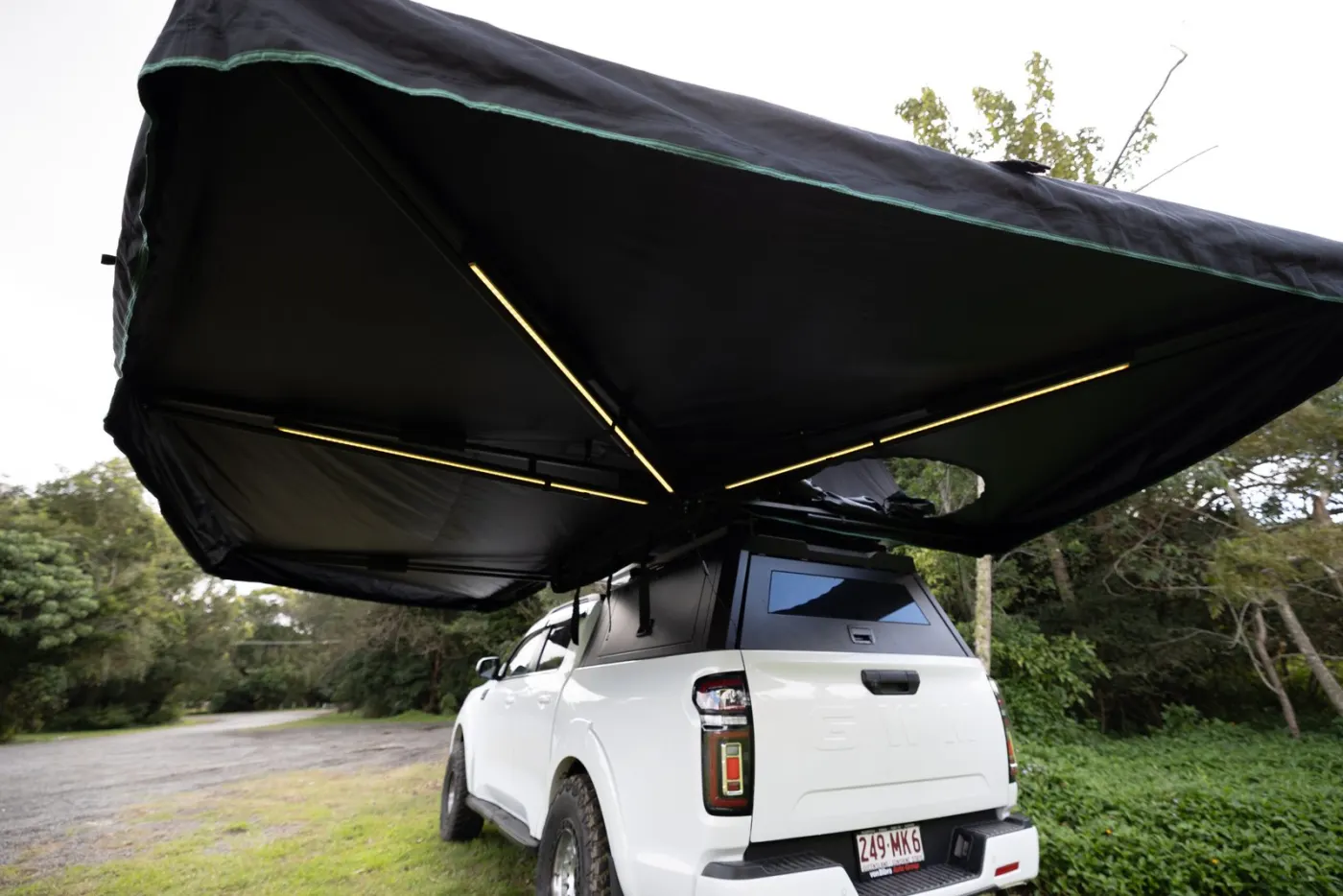
To choose a roof top tent, start with your vehicle’s roof load rating, then pick hard shell or soft shell, then pick a size that fits the people sleeping in it. After that, compare weight, setup time, canvas quality and price.
Australia throws a lot at your gear: windy coasts, dusty outback tracks and everything between. Your tent needs to work with your 4WD, not against it. This guide covers tent types, weight, size, features and the common mistakes Aussie campers make.
What is a roof top tent, and is it right for you?
A roof top tent is a sleeping shelter that mounts on your vehicle’s roof rack or cross bars. You are up off the ground, away from dirt, moisture and anything that crawls at night.
Unlike a ground tent, you do not need a flat, clear patch of earth. You get a ready-made bed wherever your vehicle parks.
Almost every model has a built-in mattress, and most let you leave your bedding inside between trips. Setup takes anywhere from about a minute to 15 minutes, depending on the style you choose.
That said, a roof top tent is not right for every camper. If you mostly stay in powered caravan parks, it is probably overkill. If you do short stays with young kids, night-time toilet runs down a ladder get old fast. A tent also adds a lot of weight to your roof, which affects fuel use and handling.
For overlanders, weekend campers and people who explore remote Australia, it earns its place in your 4WD setup.
Hard shell or soft shell: which suits Australian conditions?
| Factor | Hard Shell | Soft Shell |
|---|---|---|
| Setup Time | 30-60 seconds on gas struts | 5-15 minutes depending on design |
| Pack-Down Time | Under a minute, simple latch close | 5-10 minutes, the canvas has to be folded properly |
| Dust Resistance | Very good - seals tightly, suits outback tracks like the Gibb River Road and Simpson Desert | Moderate - fine red dust can work in through zips and canvas flaps over time |
| Ventilation in Heat | Can trap heat and moisture without good vents | Poly-cotton canvas breathes, which suits humid tropical areas like QLD and NT |
| Condensation Management | Average - depends a lot on the vents and lining | Better - canvas helps manage moisture in wet conditions |
| Internal Floor Space | Compact - limited by the size of the lid | Larger - folds out past the base, more room for the same roof space |
| Mattress Storage | Bedding stays inside the closed shell between trips | Bedding must come out, or be packed carefully to avoid mould in humid weather |
| Weight | 55-90kg depending on size and material | 40-70kg, usually lighter at the same size |
| Price Range (AUD) | $2,500 - $6,000+ | $900 - $3,500 |
| UV and Sun Resistance | A rigid aluminium, ABS or fibreglass shell handles Australian UV well | Needs UPF 50+ rated fabric - check the GSM rating (280-320gsm recommended) |
| Best Suited For | Frequent travellers, outback and dusty tracks, solo or couple setups that move camp often | Base camp setups, tropical and coastal climates, campers who want space over speed |
| Long-Term Durability | The rigid shell resists damage, but hinges and struts need checking | Canvas needs re-waterproofing over time, and zips and seams need care in wet climates |
| Verdict for Australia | Best for red dirt, remote outback and people who want convenience | Best for the tropical north, coastal camping and anyone who wants space and airflow |
Prices are a rough guide from early 2026. Check each brand’s site for today’s price.
Our hard shell vs soft shell roof top tent comparison covers this in more detail.
Will a roof top tent fit your car or ute?
Before you compare brands or features, ask one question. Can your vehicle safely carry a roof top tent at all? Cars, SUVs and utes all have a roof load limit, and some small cars are not rated for a tent.
Next, compare your cross bar spacing with the tent maker’s mounting needs. Make sure the tent will not hang too far past the sides or front of your roof. Then measure your total vehicle height with the tent closed, before you drive near a low car park or ferry deck.
On a ute, you can mount the tent on the cab roof or on a tray or tub rack. A tray or tub rack often carries more weight than the cab roof, but check the rack’s own rating. The RIGDUP fitting guide checks whether a RIGDUP tent suits your vehicle and rack.
How much does a rooftop tent weigh, and can your roof take it?
Most people assume their roof can take a tent because a mate’s LandCruiser runs one without problems. That logic gets people into trouble, because roof ratings vary a lot between vehicles.
A roof top tent weighs anywhere from 40 kg to over 80 kg. The Nomad 1.4M hard shell, for example, weighs 72 kg. Your roof has to carry that, plus the rack, the bedding and the people inside.
Your vehicle has two ratings. The dynamic rating is the weight the roof can carry while you drive. It is the number most owner’s manuals list, and it is much lower than the static rating. Most mid-size 4WDs and SUVs sit around 75 kg to 100 kg dynamic, and some family SUVs are as low as 50 kg. The tent and rack together must stay under this number. Corrugated roads and fast corners put real stress on the mounting points when the roof is overloaded.
The static rating is the weight the roof can hold while parked. It is higher, and it has to cover the tent, rack, bedding and two adults sleeping inside. Many car makers do not publish it, so ask the maker or your dealer.
A good roof rack from brands like ARB, Rhino-Rack or Thule spreads the load across strong mounting points. But a rack does not raise your vehicle’s roof rating. The lower of the rack rating and the vehicle rating is your limit. Our guide to roof rack weight limits for roof top tents walks through the maths.
What size roof top tent do you need?
Getting the size right matters. Too small means an uncomfortable night every time. Too large brings mounting and vehicle problems that are hard to fix after you buy.
For solo travellers, an inside width of around 120 cm to 130 cm works fine. It feels tight at first compared to a bed at home, but you get used to it. The weight saving and smaller footprint are worth it if you tour solo through places like the Flinders Ranges or the WA goldfields.
Couples usually find 140 cm to 160 cm wide is the sweet spot. That is about the width of a double or queen bed, which is comfortable enough for two adults on a long trip. Most mid-range roof top tents sold in Australia are made for this.
Where buyers often get it wrong is the "sleeps three" claim. Makers measure total floor area, not comfortable space for three adults with shoes, jackets and gear in the corners. If you camp with a third person or kids, look at an annex room below the tent rather than trusting the rated number. Measure the inside floor yourself and compare it to how many people will really sleep there.
Which features are worth paying for?
Some features earn their cost. Others sound good in a product listing but do little on the road.
Worth paying for:
- Mattress thickness and density: A 60mm to 75mm high-density foam mattress makes a real difference after several nights on the road. Thin foam squashes quickly and ruins your sleep on longer trips.
- Mounting system quality: Solid T-slot or heavy-duty clamp mounts stop rattling on corrugated tracks and keep the tent stable in strong wind at exposed campsites.
- Canvas GSM rating: For Australian conditions, 280gsm to 320gsm poly-cotton canvas handles UV, moisture and outback heat far better than light synthetic fabric.
- Ladder length and angle: A ladder that is too short or too steep is dangerous in the dark. Telescopic aluminium ladders with non-slip feet are worth it.
- Insect mesh quality: Australian flies and mosquitoes never give up. Fine mesh on every opening is a must.
Mostly marketing:
- Built-in LED lighting strips (a basic USB light does the same job for $15)
- Fancy carry bag designs with logos
- "Aerospace-grade" fabric claims with no GSM or UPF numbers to back them up
- Stargazing windows on tents used in fly and mosquito-heavy areas like Queensland and the Northern Territory
How does roof top tent fabric hold up in Australian heat, dust and rain?
Fabric is where a lot of buyers make an expensive mistake. They focus on the tent’s design and forget that the material decides whether it lasts two seasons or ten years.
Poly-cotton canvas is the most practical choice for Australia. It breathes in humid weather, handles condensation better than synthetic fabric, and stands up to UV that breaks down cheaper polyester surprisingly fast. Look for 280gsm to 320gsm. Anything lighter is thinner and wears faster, especially on the roof panel, which cops direct sun for hours in places like the Pilbara, outback South Australia and the Queensland interior.
UV damage is the silent killer of tent fabric in Australia. Our UV is much stronger than in Europe or North America, where most tent reviews come from. A tent without UPF 50+ fabric or a good UV coating can lose its waterproofing within a couple of seasons. Once the fabric stops shedding water, problems pile up fast, especially in tropical north Queensland and the NT wet season.
Keeping dust out comes down to seam sealing and zip quality. Re-seal your seams once a year with a product like McNett Seam Grip, treat the canvas with Nikwax Canvas Proof, and always store the tent fully dry so mould cannot take hold between trips.
How long does setup and pack-down really take?
Setup time is one of the most stretched claims in tent marketing. Think about what happens at camp after seven hours on dirt roads, when you are tired, hungry and losing the light.
Hard shell tents really do open in about a minute. On models like the iKamper Skycamp, gas struts do most of the work. You undo the latches, the lid opens, you set the ladder and you are done. The Nomad 1.4M is up in about 60 seconds with no tools. That speed matters on a trip where you move camp every day, like the Gibb River Road or Cape York.
Soft shells are a different story. A good soft shell like the Darche Panorama takes a first-timer around eight to fifteen minutes. Once you have done it twenty or thirty times, that drops to five to eight minutes. You unfold the canvas, extend the poles, secure the fly and set the ladder.
A useful tip for any tent is to pre-pack. Leave your bedding, pillow and a small torch inside before you drive. With a hard shell, your bed is ready the moment the lid opens.
How much should you budget for a roof top tent in Australia?
Price is where most decisions stall. The range in Australia is wide, and it is not always clear what you pay for at each level.
At the budget end, from $800 to $1,500, you find entry-level soft shells from lesser-known importers. Expect thinner canvas, basic 40mm to 50mm foam mattresses and limited warranty support. These suit the odd long weekend and are a fair way to test roof top camping before you spend more.
The $1,500 to $3,000 mid-range is where most Australian buyers land, and where the jump in quality is easiest to see. Brands like Darche and 23Zero sit here, with 280gsm-plus canvas, thicker mattresses, better airflow and proper Australian warranty and parts support. If you camp six to fifteen times a year, this range covers most needs.
Above $3,000, and past $6,000 for premium hard shells like the iKamper Skycamp 3.0, you pay for faster setup, better insulation, stronger build quality and materials made for heavy use. Add a roof rack at $400 to $1,500, an annex if you need one, and accessories, and your total setup can reach $5,000 to $7,000 before you leave the driveway.
Which roof top tent brands are worth buying in Australia?
Warranty support, spare parts and local know-how vary a lot between brands. A well-reviewed overseas brand is little help if the local distributor cannot get you a strut or zip before your trip.
RIGDUP is a Gold Coast brand with a workshop in Molendinar. Its Nomad 1.4M is a clamshell hard shell with a 255W solar panel, a power socket and cross bars in the box, and a 2 year warranty. It sleeps 2 adults, so it is the wrong pick for a family of 4.
Darche has been a known name in Australian camping for years and sits in the mid-range. You will find its tents stocked and serviced across the country. ARB has deep roots in the Australian 4WD community, and its national service network helps when something needs fixing between trips.
iKamper is a popular premium hard shell brand in Australia. With any overseas brand, check local stock and spare parts before you buy.
Do you need a roof rack first?
Yes, in most cases you need a proper roof rack before you mount a roof top tent. Skipping this step causes real safety problems. Here is what to know before you buy the rack or the tent.
Factory cross bars
- Factory cross bars often have a dynamic rating of 50 kg to 75 kg, which is often not enough for a tent on the move
- Some factory bars have no T-slot channels, which makes tent mounting hard or impossible without adaptors
Why a dedicated rack helps
- Good aftermarket racks mount to strong points on the vehicle, not just the roof skin
- Brands like ARB, Rhino-Rack, Thule and Yakima make racks rated for roof top tents, but your vehicle’s roof rating still applies
Cross bar spacing
- Every tent needs a set gap between the cross bars
- Check the tent maker’s minimum and maximum spacing before you buy the rack, as it varies by brand and size
Platform rack vs load bars
- Platform racks give the most stable mounting surface and the easiest tent fitting
- Load bars work well, but the bar width must match the tent’s mounting feet
Bolt torque
- Always tighten mounting bolts to the torque the tent and rack makers list, and check them again after the first 100 km
How does a roof top tent affect fuel use and driving?
Most buyers do not think about this until they are filling up more often than expected on their first long trip.
The main issue is drag. A tent puts a large, blunt object on top of your vehicle, which disrupts airflow at highway speed. Drag rises with the square of your speed, so the faster you go, the worse the fuel penalty gets. As a rough guide, expect fuel use to rise by around 10% to 20% at 100 km/h, depending on the vehicle, the tent size and whether a cover is fitted while driving.
On slow off-road tracks in places like the Kimberley or the Flinders Ranges, the effect drops a lot, because drag at 40 km/h to 60 km/h is a fraction of what it is on the highway. You feel the tent most on long highway runs between destinations. Over a 3,000 km trip, that extra fuel adds up.
The other change is a higher centre of gravity. A tent weighing 60 kg to 80 kg on your roof adds body roll in corners and affects stability in sudden lane changes. You can manage this by driving a little gentler, but the vehicle will feel different, especially on winding coastal roads or mountain passes in Victoria and New South Wales.
Can you leave a roof top tent on your car full-time?
Plenty of Aussie overlanders leave their tent on all the time, and it works well when you know what you are signing up for. Being ready to camp at any moment is hard to give up, especially if you head out every second or third weekend to places like the Victorian High Country.
Full-time mounting comes down to three things: UV damage to the cover, vehicle height and moisture. A good weatherproof cover is a must if the tent lives on the roof year-round. Without one, Australian sun breaks down canvas and stitching much faster. A new cover costs far less than replacing the whole tent fabric early.
Height catches people out more than you would expect. A tent raises your total height by around 200 mm to 400 mm, depending on the model and your rack. The Nomad 1.4M is 18 cm tall closed, plus the height of your rack. Many multi-storey car parks in Australian cities have a 2.1 metre limit, and car washes, ferry decks and some campground gates cause the same problem. Measure your total height with the tent closed and keep that number somewhere you can see it.
Moisture is the other ongoing concern. Even with the tent closed, humidity gets inside. Air the tent out fully every two to three weeks, check the canvas for early mould spots, and never close it up while anything inside is damp.
What do first-time buyers often get wrong?
The same few mistakes come up again and again. Most are not about brands. They are about things people assumed before they bought.
The most common one is underestimating condensation in tropical and coastal areas. People heading to Far North Queensland, the NT Top End or the Kimberley in the build-up season are often caught off guard by how much moisture builds up overnight, especially in hard shells with less breathable linings. Good vents, a mesh mat under the mattress and a breathable liner all help. Our guide to stopping condensation and mould in a roof top tent covers what works.
Wind is the second one. Ground tents sit low and get some shelter from trees and terrain. A roof top tent sits 1.5 to 2 metres off the ground with nothing around it. Coastal campsites along the Great Ocean Road, the Nullarbor or the WA coast can get strong gusts that make sleeping hard in a poorly braced setup. Stabiliser legs and good ladder feet become important, not optional.
The third is not checking total vehicle height before the first trip. Driving into a 2.1 metre car park and hearing the tent scrape is easy to avoid with a two-minute measurement before you leave home.
Roof top tent checklist: what to compare before you buy
Use this checklist when you compare tents in a store or online.
Before you buy, confirm these:
- What is your vehicle’s static and dynamic roof load rating? Check the owner’s manual, not a forum post.
- Do you have a rated roof rack, or do you need to budget for one?
- Hard shell or soft shell, based on your main terrain and how often you move camp?
- What is the inside floor size, not the "sleeps X" claim?
- What GSM is the canvas, and is it rated UPF 50+ for Australian sun?
- What is your total vehicle height with the tent closed?
- Does the brand have Australian warranty support and spare parts?
- What cross bar spacing does the tent need, and does it match your rack?
- Have you seen the tent opened and closed before you buy?
Want a hard shell that comes with cross bars and a solar panel? See the RIGDUP Nomad 1.4M roof top tent.
FAQs
Can a rooftop tent damage my car’s roof over time?
It can, if the tent and rack go over your vehicle’s roof rating or the tent is mounted badly. A properly rated roof rack spreads the weight across strong mounting points, which protects the roof and keeps everything safe long-term.
How do I stop my rooftop tent getting mouldy between trips?
Always pack the tent away completely dry. If you camp in humid conditions in Queensland or the Northern Territory, air the tent fully before you close it. A light coat of Nikwax Canvas Proof every season keeps the fabric protected and cuts the chance of mould.
Is a rooftop tent suitable for beach and coastal camping in Australia?
Yes, but the coast brings two challenges: salt air and wind. Rinse the mounting hardware and ladder often to stop corrosion, and use stabiliser legs at exposed sites. Canvas tents handle salt air better than cheaper synthetic fabrics over the long run.
Do rooftop tents work in winter in alpine areas like the Snowy Mountains?
They do, but warmth becomes the priority. A 60mm to 75mm high-density foam mattress helps stop the cold coming up through the floor. A thermal liner inside the tent makes alpine winter camping much more comfortable without buying a new tent.
Which roof rack brands suit a rooftop tent in Australia?
ARB, Rhino-Rack and Thule are widely used in Australia for roof top tents. Each offers platform racks and load bars rated for tents, with broad vehicle fitment and Australian warranty support, which matters when you tour remote areas.