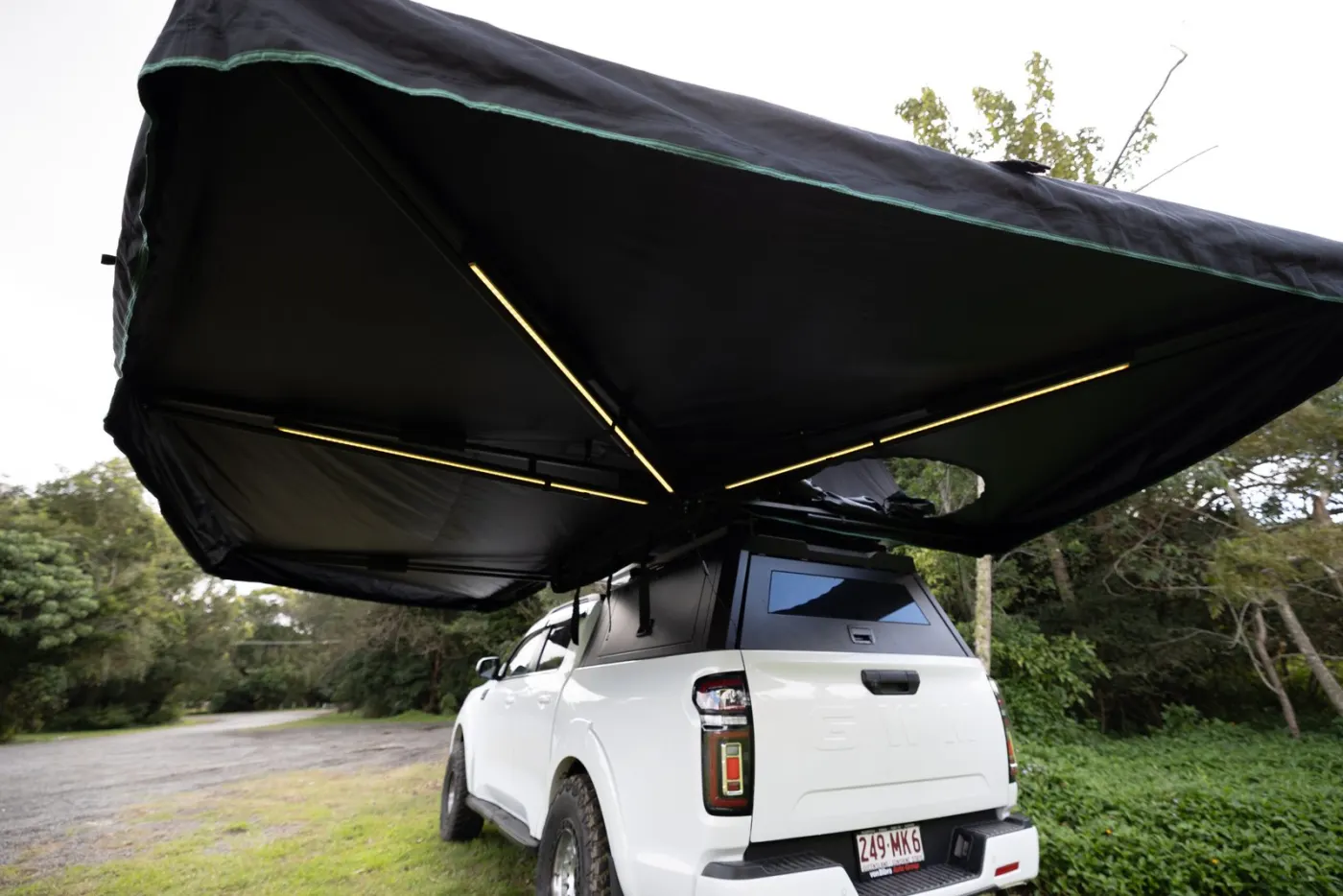
A rooftop tent fan is a small USB, 12V or rechargeable fan you hang inside the tent to move air while you sleep. On its own it helps a little: pair it with shade, open windows on both sides and a spot that catches the breeze, and a hot night in a roof top tent becomes a comfortable one.
Here's what works, in order of how much difference it makes:
- Park in afternoon shade: a tent that sat in the sun all afternoon starts the night hot
- Open the tent early: let the heat out an hour or two before bed
- Open windows on opposite sides: air in one side, out the other
- Turn the tent to the breeze: point the door or biggest window into the wind
- Add a fan: it keeps air moving when the breeze drops
- Sleep light: a cotton sheet beats a sleeping bag on a 28°C night
Do You Need a Fan in a Rooftop Tent?
You need one if you camp in summer, up north, or anywhere the night stays warm and still. A breeze does most of the work in a roof top tent, but breezes die off after dark on plenty of Aussie nights, and two people breathing in a closed space heats it up fast.
A fan also helps with moisture. Moving air carries the damp from your breath out through the windows before it settles on the walls. If you have ever woken up to a wet ceiling, our guide to stopping condensation and mould in a roof top tent covers the rest of that fix.
A fan doesn't cool the air, it only moves it. The real gains come from shade and airflow first.
What Type of Rooftop Tent Fan Should You Buy?
Buy the type that matches the power you already have. If your tent has a USB port, a USB fan is the simplest. If you run a 12V battery, a 12V fan is the most efficient. If you want no cables at all, go rechargeable.
| Fan type | Power from | Good for | Watch out for |
|---|---|---|---|
| USB fan (USB-C or USB-A) | A USB port, power bank or battery box | Light, cheap, easy to clip or hang | Smaller blades, less airflow |
| 12V fan | A 12V socket or wired to a 12V battery | More airflow for very little power | Needs a cable run, some need wiring in |
| Rechargeable fan | Its own battery, charged by USB | No cables, move it anywhere | Runs flat, often on the hottest night |
Things to look for in any tent fan:
- A hook or clip: so it hangs from the roof, not on the mattress
- Low noise, a timer and more than one speed: low speed is often all you need
- Stated power draw: watts or amps on the box, so you can work out what it uses
The RIGDUP Nomad 1.4M has USB-C, USB-A and a 12V socket, so you can plug in a USB fan or a 12V fan with a socket plug, or top up a rechargeable one, as long as the ports have a battery behind them.
How Much Power Does a Tent Fan Use Overnight?
A good 12V fan uses very little, usually a few amp-hours a night. You can check any fan with one sum: watts = volts x amps, then watts x hours = watt-hours used.
Here's that sum with a real maker's figures. Caframo lists its Sirocco II 12V fan at 0.12 A on low and 0.35 A on high at 12 V.
| Speed | Maker's draw at 12 V | Watts (12 x amps) | 8 hours (watts x 8) | Amp-hours (amps x 8) |
|---|---|---|---|---|
| Low | 0.12 A | 1.44 W | about 11.5 Wh | about 1 Ah |
| High | 0.35 A | 4.2 W | about 33.6 Wh | 2.8 Ah |
So on a 100 Ah 12 V battery, that fan on high for 8 hours uses 2.8 Ah, under 3% of the battery. Real draw shifts a little with battery voltage, but the sum gets you close. The Sirocco II is built to be wired in, so plan for a plug or an auto electrician if you go that way.
For a rechargeable fan, use the battery size instead. Run time in hours = battery watt-hours divided by the fan's watts. If the box only gives mAh, multiply by 3.7 (a typical lithium cell voltage) and divide by 1,000 to get watt-hours. As a worked example only: a 10,000 mAh fan battery is about 37 Wh, and at 5 W that's about 7 hours. Plug in the numbers from your own fan's box.
Can You Run a Fan Off Your Roof Top Tent's Solar Panel at Night?
Not directly. A solar panel makes no power after dark, which is exactly when you want the fan. Whatever you plug the fan into at night is running off a battery, whether that's a power bank, a battery box or your vehicle's second battery.
The panel's job is to put back in the day what the fan and lights used overnight. The Nomad 1.4M comes with a 255W solar panel included, and a 4 W fan is a small load next to that. Check the product page for what's in the box and how it connects, and plan on your own battery unless the page says otherwise.
Keep the fan off your vehicle's starting battery, or you risk a flat battery in the bush.
Where Should You Park a Rooftop Tent to Keep It Cool?
Park where the tent gets shade in the afternoon and catches any breeze. The afternoon sun from the west heats the tent most, so a tree or hill on the western side does more than morning shade.
- Face the breeze: point the door or the biggest window into the wind, so air pushes straight through
- Go a little higher: rises and open ground catch more breeze than gullies
- Avoid hot ground: rock, gravel and bitumen give off heat well into the night. Grass stays cooler
- Check the trees: shade is good, but never park under dead branches or big gums that drop limbs
- Check the forecast: the Bureau of Meteorology gives the overnight low and wind direction, so you know which way to face
If you can't get shade, open the tent as soon as you stop, even hours before bed. A closed tent bakes on the roof.
How Do You Use Vents and Mesh to Cool a Roof Top Tent?
Open windows on opposite sides so air can flow straight through the tent. One open window barely moves air. Two facing windows give you cross-flow, and that's where most of the cooling comes from.
- Zip the canvas window flaps fully open and leave only the mesh closed, so bugs stay out and air still moves
- Roll back any rain flap or cover on a dry night
- Open the windows nearest your head, where you feel the airflow most
- Keep the mesh clean. Dust and pollen clog it and slow the air
- If rain is coming, leave the mesh closed and open the flap a little on the side away from the wind
Hang the fan near one open window and aim it to push air out the far side, or let it blow across your face and upper body. Warm air rises and sits under the roof, so pushing it out up high works well. Try both and see which feels better.
Poly-cotton canvas helps too, because it breathes. We cover how that compares to other tent builds in hardshell vs softshell roof top tents.
What Else Keeps You Cool in a Roof Top Tent?
Light bedding and a few habits help a lot. Swap the sleeping bag for a cotton sheet, put a damp cloth on your neck with the fan blowing over it, and have a cool shower or swim before bed. Keep bags and spare bedding out of the tent, because piled-up gear traps heat and blocks airflow. Add a sheet and a fan to the kit list in what to pack for an Aussie 4WD trip.
FAQs
Is a USB fan strong enough for a roof top tent?
For a couple on a warm night, often yes. A small USB fan moves enough air across your face and body to feel cooler. On very hot, still nights, a larger 12V fan moves more air for very little extra power.
How do I hang a fan in a roof top tent?
Use the fan's own hook or clip on a roof pole, cross bar or loop inside the tent. Keep the cable tidy and away from the hinge or folding points, so it doesn't get pinched when you close the tent. Take the fan down before you pack the tent away.
Want a hardshell with USB-C, USB-A, a 12V socket and a 255W solar panel included? See the RIGDUP Nomad 1.4M roof top tent.