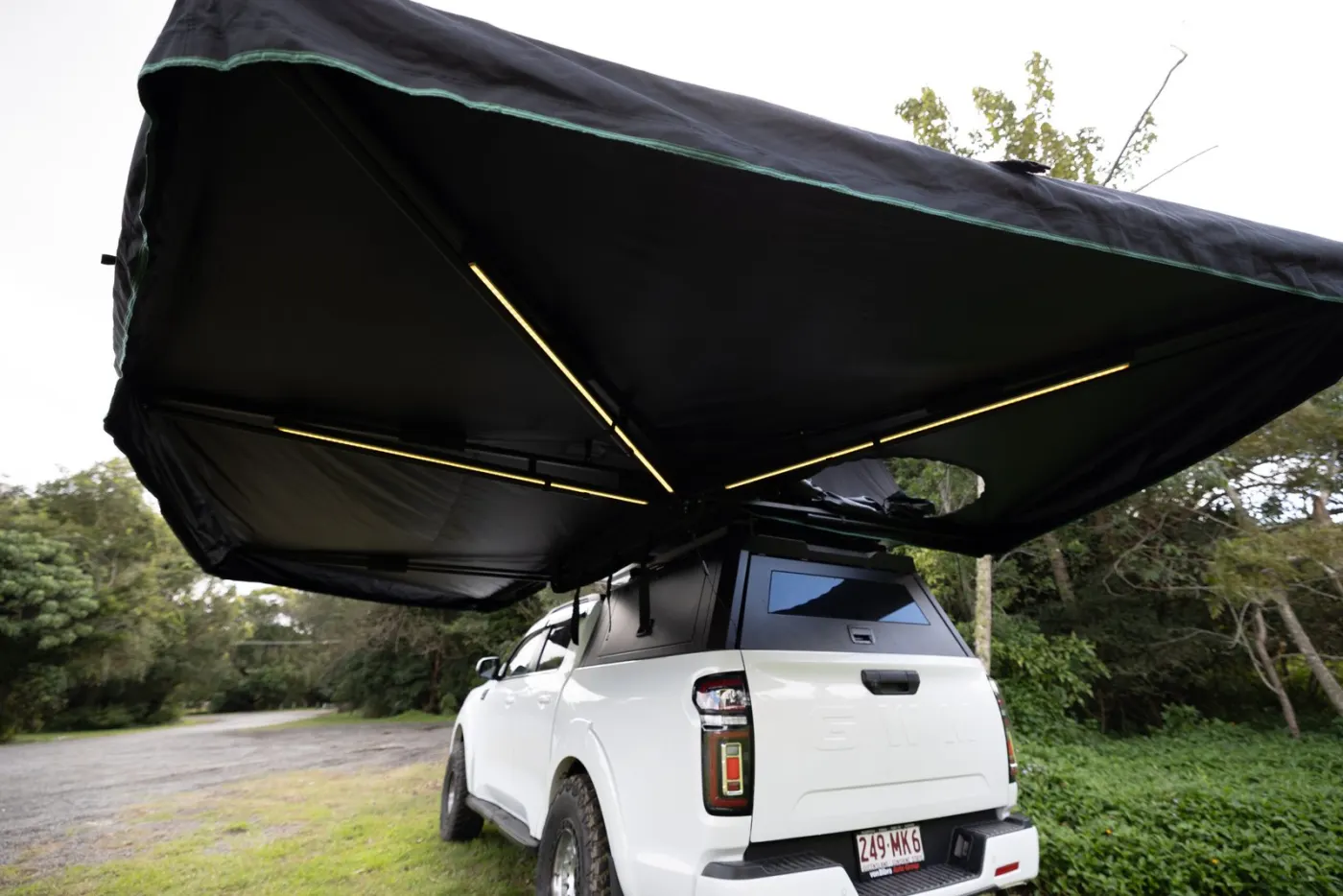
A clamshell roof top tent is a hardshell tent hinged at one end, so the lid swings up at the other end and leaves a wedge-shaped space inside: tall at the open end, low at the hinge. Gas struts do the lifting, so setup is quick. The RIGDUP Nomad 1.4M is up in about 60 seconds.
It suits couples who move camp often and mostly sleep in the tent. It is weaker if you want a big floor or room to sit up. This guide covers how a clamshell opens, its pros and cons, and how it compares with a pop-up tent and a side opening tent.
How Does a Clamshell Roof Top Tent Open?
You release the lid, lift the free end, and the gas struts carry it up and hold it there. The hinged end stays put and the canvas unfolds as the lid rises. Packing down is the reverse: lower the lid, check the canvas is tucked in, and close it up. Your tent's manual covers the exact latch and handle steps.
Steps vary a little between makers, but the order is much the same:
- Release the lid as the manual shows.
- Lift the free end. The struts take most of the weight.
- Fit the ladder and check it is steady.
- Climb in and open the windows and vents.
On many clamshells the mattress stays inside when the lid is shut. Check how much bedding your tent closes over before your first trip.
The Nomad 1.4M opens like a clamshell. Its aluminium shell hinges up at one end on gas struts.
What Are the Pros of a Clamshell Roof Top Tent?
The main pros are speed, a low closed height and a simple build. A clamshell has few moving parts, so there is not much to set up.
- Fast setup. Lid up on gas struts and you are close to done. That suits people who move camp most days or arrive after dark.
- Low when closed. The lid shuts flat, so a clamshell is often lower when closed than a fold-out. The Nomad 1.4M is 18 cm closed.
- Bedding can stay in on many models. Check yours.
- Parking choice. A sloped end can be pointed into the wind, but wind is a risk for any tent, so check the maker's wind guidance and pack down in strong gusts.
- Few parts. No poles to lose.
What Are the Cons of a Clamshell Roof Top Tent?
The main cons are uneven headroom, a floor limited to the size of the shell, and weight on the roof. None of these is a deal breaker, but they are worth knowing before you buy.
- Sloped roof. You can sit up at the high end, but not at the hinge end. Two people sit side by side at the tall end with their legs under the low part.
- Floor is the size of the shell, so a clamshell often sleeps fewer people than a fold-out of a similar size. The Nomad 1.4M sleeps 2.
- Weight. A hard shell is heavier than many soft tents. The Nomad 1.4M is 72 kg, and that has to sit within your vehicle's roof load rating and your rack's rating. See our guide to roof rack weight limits.
- Ladder position. Check where the ladder fits on the tent you are buying, and think about which way the door faces before you park.
How Does a Clamshell Compare With a Pop-Up or Wedge Tent?
A clamshell lifts at one end only, while a pop-up lifts the whole roof straight up on all four corners. Pop-ups give even headroom across the whole tent. Clamshells are simpler.
Some people call any hardshell that rises at an angle a "wedge" tent, and that includes a clamshell. A true pop-up is different: the roof stays level as it rises, so you can sit up anywhere inside. The trade-off is more hardware at the corners.
| Clamshell | Pop-up | |
|---|---|---|
| How the roof moves | Hinged at one end, lifts at the other | Rises level on all four corners |
| Headroom | High at one end, low at the other | Even across the tent |
| Setup | Lid lifts on gas struts | Roof raises on all four corners, with more hardware to move |
| Closed height | Check the spec sheet | Check the spec sheet |
| Suits | People who move camp often and mainly sleep in it | People who want to sit up anywhere inside |
These are general traits, not tested figures. Models vary a lot, so compare the closed height, weight and inside size on each maker's spec sheet instead of the style name.
How Does a Clamshell Compare With a Side Opening Tent?
A side opening tent hinges along one long edge, so the lid tilts up over the side of the vehicle and you climb in from the side. A clamshell hinges at one end. The sleeping area can be similar, but the headroom and door position differ.
| Clamshell | Side opening | |
|---|---|---|
| Hinge | At one end | Along one long edge |
| Headroom | Tall at the head end only | Tall along the full length of one side |
| Door and ladder | Check each model | The side of the vehicle |
| In wind | Parking direction matters. Follow the maker's wind guidance. | Parking direction matters. Follow the maker's wind guidance. |
| Awning fit | Check where the door and ladder sit before choosing an awning side | Check where the door and ladder sit before choosing an awning side |
Our full guide to the side opening roof top tent goes through how each one feels to live in. If you are still choosing between a hard and soft tent, start with hardshell vs softshell.
Who Is a Clamshell Roof Top Tent Right For?
A clamshell suits people who camp for a night or two at a time, move on most mornings and mainly use the tent to sleep. It is a good match for couples. It is a weaker match if you want a big floor, room for more than two, or space to sit up and read.
A clamshell is probably right if you:
- Arrive late and want to be in bed quickly
- Want a low profile on a daily driver
- Can choose which way to park
- Are happy with a bed for two
Look at another style if you:
- Need room for 3 or more
- Stay several nights in one place and want a larger living space
- Want to sit up in the tent along its full length
What Should You Check Before You Buy a Clamshell Roof Top Tent?
Check the weight, closed height and footprint against your vehicle and rack before anything else. A tent is only useful if the roof can carry it safely.
- Weight against the lower of your vehicle's dynamic roof load and your rack's rating. Find yours in the owner's manual and the rack maker's instructions.
- Closed height plus rack height, against your garage and the car parks you use. Measure it rather than guess.
- Footprint against your roof length and rack spread.
- Ladder reach from the ground to the top of the rack.
- Mattress depth and whether your bedding fits with the lid shut.
- What is in the box, such as cross bars, a ladder and power.
The RIGDUP fitting guide walks through these checks for your vehicle.
What Are the Nomad 1.4M's Specs?
The Nomad 1.4M is a clamshell hard shell that sleeps 2 and opens on gas struts. Here is what the specs say:
| Spec | Nomad 1.4M |
|---|---|
| Style | Clamshell hard shell, gas struts |
| Sleeps | 2 |
| Inside | 210 x 145 cm |
| Open size | 217 x 150 x 150 cm |
| Closed size | 217 x 150 x 18 cm |
| Weight | 72 kg |
| Shell and base | Aluminium shell, aluminium honeycomb base |
| Canvas | 320gsm ripstop poly-cotton, PU3000mm, UV50+ |
| Mattress | 70mm memory foam |
| Power | USB-C, USB-A and 12V socket, 255W solar panel included |
| In the box | Cross bars, 2.6 m ladder |
| Setup | About 60 seconds |
| Warranty | 2 years |
FAQs
Is a clamshell roof top tent the same as a pop-up?
No. A clamshell lifts at one end and leaves a sloped roof. A pop-up raises the whole roof level on all four corners.
Is a clamshell roof top tent a hard shell or a soft shell?
A hard shell. The lid and base are rigid panels, and the canvas folds inside when it is shut. You may also see it written as a "clam shell roof top tent". It is the same thing.
How long does a clamshell take to set up?
Gas struts lift the lid, so setup is quick. The Nomad 1.4M is up in about 60 seconds.
Can two adults sleep in a clamshell?
Check the inside size on the spec sheet. The Nomad 1.4M is 210 x 145 cm inside and sleeps 2.
Does a clamshell handle wind well?
Parking so the sloped end faces the wind can help, but no tent is wind proof. Follow the maker's guidance and pack down if gusts build.
Is a Clamshell Roof Top Tent Right for Your Rig?
If you want a quick tent for two and your roof and rack can carry it, a clamshell is a sensible choice. See the full specs and what is in the box on the RIGDUP Nomad 1.4M page, or browse all roof top tents.