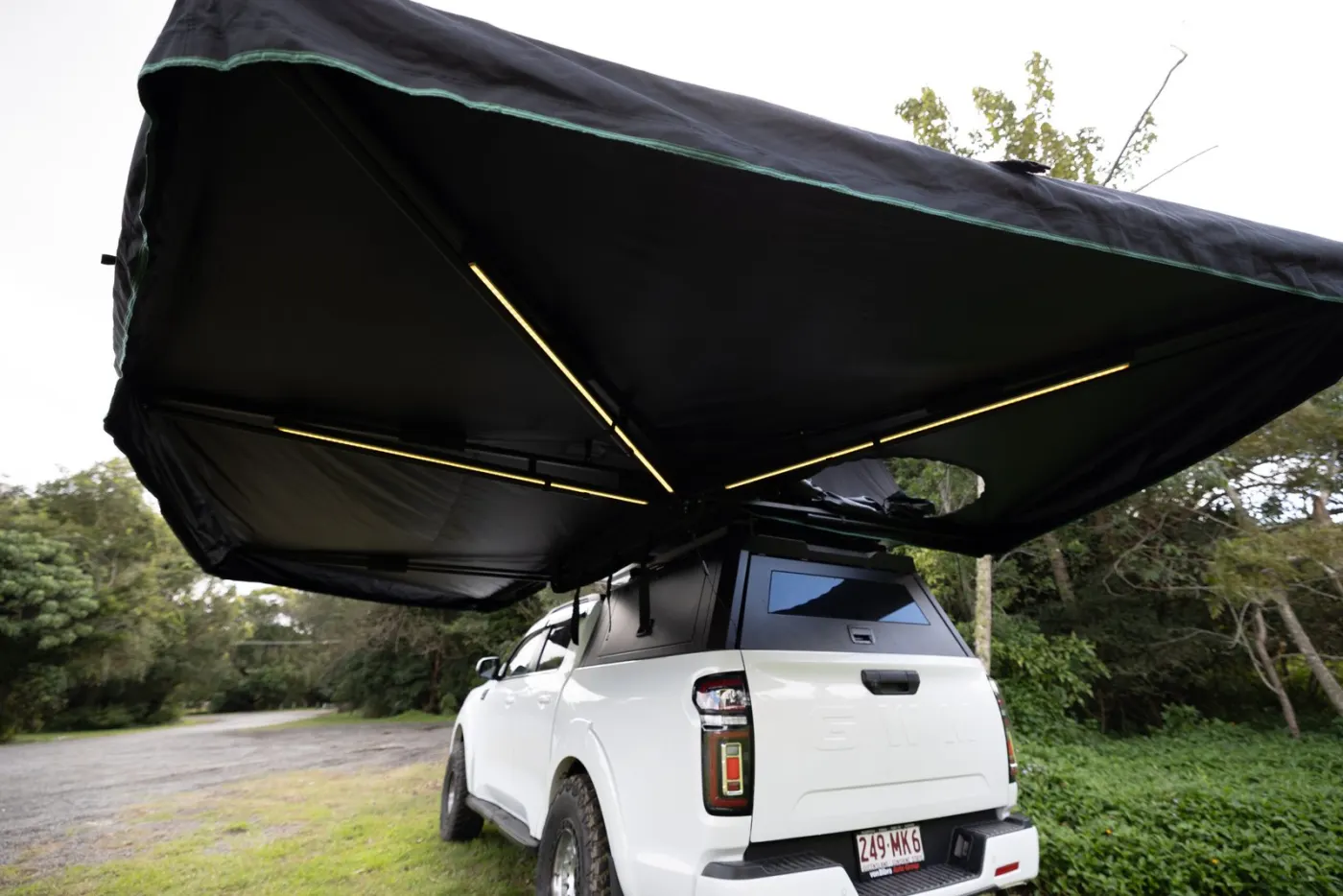
Most people don't need an electric roof top tent. A gas strut clamshell opens in about a minute with no motor, no battery and nothing to flatten, and it is the simplest kind of "auto" tent to own and fix a long way from help.
Whether you want one with a motor comes down to your back, your budget and how far from a workshop you camp. This post explains the main types in plain terms, what each one costs you in moving parts and power, and who is better off with which.
What Is an Automatic Roof Top Tent?
An automatic roof top tent is one that opens with little or no effort from you. Some use gas struts, some use a hand crank, some use an electric motor, and some just pop up when you undo the latches. The word "auto" covers all of these, so always ask how the tent actually opens.
Here are the common types in general terms:
| Type | How it opens | Needs power? |
|---|---|---|
| Gas strut clamshell | Undo the latches and the struts lift the lid open | No |
| Hand cranked | You turn a handle to raise or lower it | No |
| Motorised | A motor opens and closes it at the push of a button | Yes |
| Pop up softshell | Frame and poles spring up when you release the cover | No |
| Fold out softshell | You unfold it and the ladder holds it up | No |
Not every tent fits neatly in one row, and makers use the words loosely. Check the maker's own spec to see what moves the tent and what power it draws.
Is There Such a Thing as an Electric Roof Top Tent?
Yes, some tents use an electric motor to open and close the lid or frame. The idea is simple: press a button and the tent opens, with no lifting or cranking. It appeals to anyone who wants the quickest, easiest setup.
What you give up is simplicity. A motorised tent adds a motor, wiring, a switch or remote, and a power source to run it. Each part is one more thing that can fail, get wet or need repair. A motor also needs a supply, so the tent has to link to your car battery or a separate battery, and you need to keep that charged.
That doesn't make electric tents a bad choice. For someone with a bad shoulder, or who sets up in a tight spot many times a trip, a button can be worth it. It just means you should ask what happens if the power fails. Some motorised tents may have a manual backup, but check the maker's own spec rather than assume.
What Are the Trade-Offs of a Motorised Roof Top Tent?
You trade simplicity, weight and reliability for convenience. Here is how the main points compare.
- Moving parts: every motor, gearbox, cable and switch is a part that can wear, corrode or jam. Fewer parts mean fewer things to go wrong
- Power draw: a motor runs on 12V, so it uses your battery each time. A weak or flat battery means a tent that is stuck shut or stuck open
- Weight: motors, wiring and extra framing add kilos on the roof. That counts against your roof and rack limits, so read our post on roof rack weight limits
- Repair in the middle of nowhere: a strut or latch is easy to understand and often easy to swap. A failed control box on a remote track is a harder problem
- Water and dust: roof top parts see rain, dust and corrugations, and electrics dislike all three
- Cost: motors and controls usually add to the price
Hand cranks sit in the middle. They need no power, but they take effort and time, and a crank mechanism is still a set of moving parts.
Do You Need an Electric Roof Top Tent?
You probably don't, unless you have a physical reason to want one. A gas strut clamshell already gives you most of the benefit, because the struts do the lifting for you. Most people find that opening a latch and letting the lid rise is easy enough.
Here is a simple way to decide:
- Can you lift your arms above your head and push a latch? If yes, a strut tent is likely easy for you
- Do you camp far from workshops and phone signal? Fewer moving parts is a safer bet
- Do you set up and pack up daily? Speed matters more, and either a strut or a motor works
- Do you have a limited roof rating? Look hard at weight
- Do you need a button for a physical reason? A motorised tent may be worth the extra parts
If you answered "no" to the last one, a strut tent covers you. For a look at how one works, read our post on the clamshell roof top tent.
How Does a Gas Strut Roof Top Tent Open Without a Motor?
It uses gas struts, which are sealed cylinders that push outward with steady force. When you undo the latches, the struts take most of the lid's weight and lift it open. To close it, you pull the lid down against the struts and fasten the latches.
That is a very short list of moving parts. There is no battery, no wiring and no motor. A strut can wear over the years, and a flat battery in your car can't stop the tent from opening.
The RIGDUP Nomad 1.4M works this way. It is a clamshell hardshell on gas struts, and it opens like a clamshell. It goes up in about 60 seconds, so you can set camp quickly after a long drive, or open up fast when the weather turns.
Can a Roof Top Tent Have Power Without a Motor?
Yes. A tent can have power for your phone, lights and small gear without using any of it to open or close. That is a different job from a motor, and it is useful on its own.
The Nomad 1.4M includes a 255W solar panel, and the tent has USB-C, USB-A and 12V sockets for charging your gear. There is no motor to power, so there is no motor battery to flatten while you sleep.
If you want more on running power at camp, see our post on a roof top tent with a solar panel.
What Else Should You Check on Any Auto Roof Top Tent?
Whatever type you pick, ask a few plain questions before you buy:
- How long does it take to open and close, with one person?
- What happens if it fails halfway, and is there a manual backup?
- How much does it weigh, and does that fit your roof and rack ratings?
- Which parts can you replace yourself, and which need the maker?
- How long is the warranty, and what does it cover?
- Does it come with a ladder, cross bars and power gear?
Ask for answers from the maker's own spec rather than a reseller's summary. Every figure you can compare on paper is one less surprise in the bush.
FAQs
Are automatic roof top tents worth it?
They can be, if the type suits how you camp. A strut tent gives easy setup with very few parts. A motorised one adds a button but also adds parts and a power need.
What happens if a motorised roof top tent loses power?
It depends on the tent. Some have a manual override, some don't. Check the maker's own spec before you buy and test the backup at home.
Do gas struts wear out?
Over time, yes, like any strut on a car boot. They are standard parts, and replacing a strut is much simpler than diagnosing a motor.
Does a solar panel on a tent open it?
No. On the Nomad 1.4M, a 255W solar panel is included and the tent has USB-C, USB-A and 12V sockets. It opens on gas struts with no motor.
Which Roof Top Tent Opens Fast With No Motor?
If you want the speed of an auto tent without the extra parts, a gas strut clamshell is the simple pick. The Nomad 1.4M sleeps 2, opens in about 60 seconds on gas struts, and includes a 255W solar panel for its sockets. See the RIGDUP Nomad 1.4M roof top tent.